WhatsApp just changed their pricing. And if you use WhatsApp as a business, you are going to pay a lot more.
Starting from October 1, you need to pay for every message that you send. Even when you reply to customers who messaged you first.
These replies used to be free, but now they will cost you money.
I went through Meta’s new pricing rules, and here’s what you will learn:
- What changed with WhatsApp Business pricing
- How much you will pay, per country
- The one exception where WhatsApp stays completely free
- What I would do in your situation
Let’s get started!
The short version
- From October 1, 2026, you pay for every reply you send through the WhatsApp Business API
- You pay per message, not per conversation. Ten replies to one customer means you pay ten times
- Every business phone number gets 1,000 free service messages a month. After that you pay your country’s rate, which runs from 0.14 cents in India to 5.5 cents in Germany
- Click-to-WhatsApp Ads are the exception. They open a 72-hour window where every message you send is free
- Nothing changes if you use the WhatsApp Business app on your phone and reply by hand
What changed with WhatsApp pricing
From October 1, 2026, every message you send on WhatsApp costs money.
That includes the replies you send to customers who message you first, and those used to be completely free.
Does this apply to you?
This change is about the WhatsApp Business API. So if you use a chatbot platform like Manychat, or any other WhatsApp chatbot platform, it applies to you.
But if you use the WhatsApp Business app on your phone and answer customers by hand, nothing changes. That stays free.
The old situation: replying was free
The old pricing was simple. When a customer sent you a message, a 24-hour window opened.
Inside that window you could reply with anything you wanted, and it did not cost you a cent. Every new message from the customer reset the window.
Outside the window you could only send message templates. These are messages WhatsApp approves upfront, and you always paid for those.
Think of marketing broadcasts, but also the login codes people get for two-factor authentication.
So the old situation came down to one line: reaching out to people cost money, and replying to people was free.
What changes from October 1
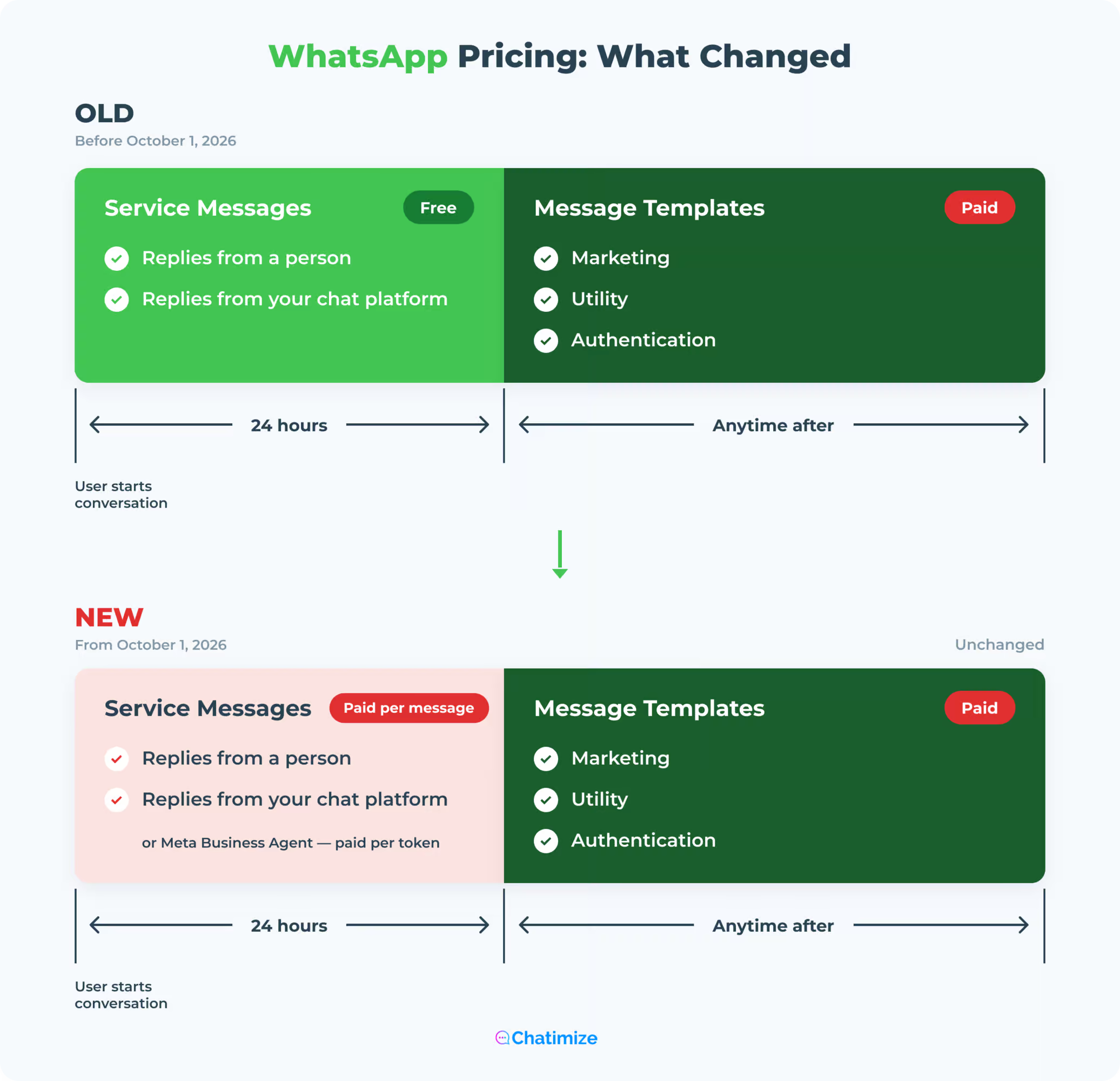
Starting from October 1, the free part disappears. Every reply you send inside that 24-hour window now costs you money, and you pay for each one separately.
This is the old and the new situation next to each other:
There are now two kinds of replies, and you pay for both of them:
- Service messages: every reply sent by a person or a third-party chat platform
- Meta Business Agent: Meta’s own AI agent that replies to your customers for you
This is what each one costs:
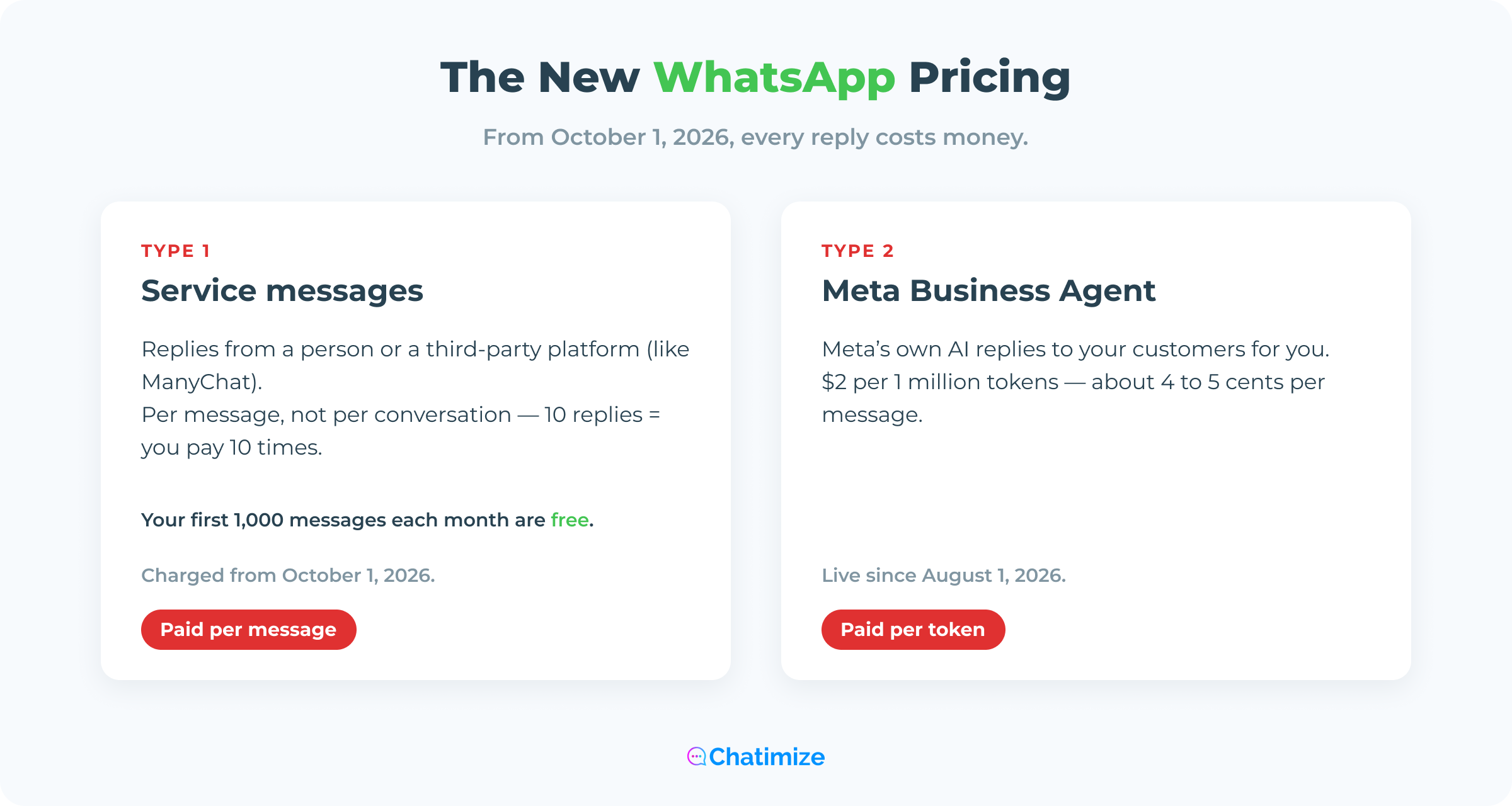
If you use a third-party chat platform, you need to pay for every service message. And that is the detail most people miss, because you pay per message and not per conversation.
If a customer asks one question and you send ten replies, you pay ten times.
If you use the Meta Business Agent, you don’t pay per message, but per tokens used, similar to tools like ChatGPT and Claude.
This costs 2 dollars per million tokens, which works out to 4 or 5 cents per message.
So either a person or your chat platform replies and you pay per message, or Meta’s AI replies and you pay per token.
Note: In the rest of this post, I will focus on service messages. I tested the Meta Business Agent, and I don’t think it’s worth switching to, since it’s too basic.
How much does it actually cost?
Every business phone number gets 1,000 free service messages a month, and Meta only starts charging from the 1,001st.
Those free messages reset every month and do not roll over, so an unused month is simply gone.
After that, what you pay depends on the country of the person you are messaging.
The official rates are on the Meta website, where you can download the rate card for your own country and currency. But here are the rates of some markets:
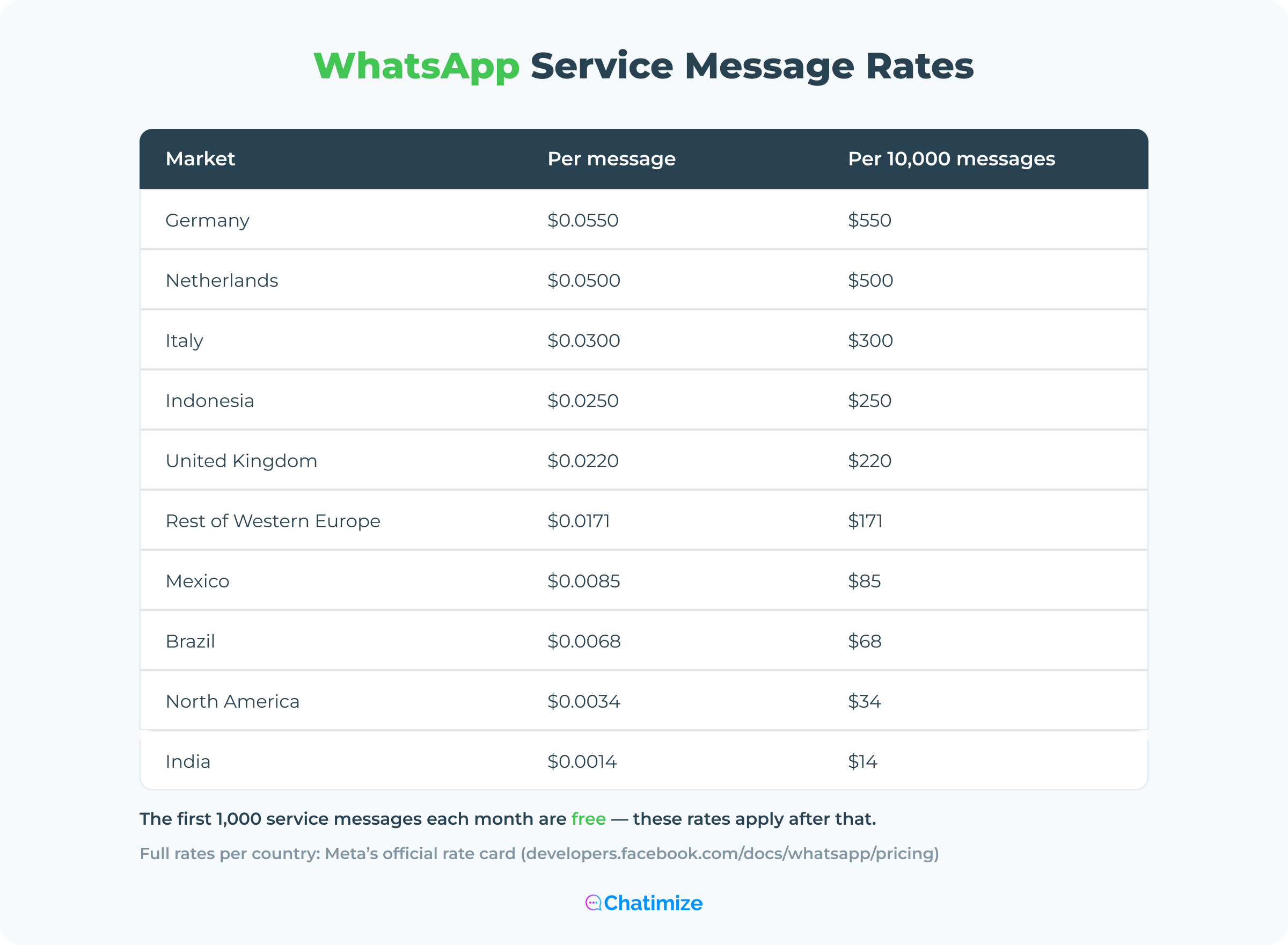
Germany is the most expensive country on the whole list at 5.5 cents per message, and here in the Netherlands it is exactly 5 cents.
But the United States costs a third of a cent, and India is almost free.
So let me make that concrete. Say you send 10,000 messages a month:
- Germany: $550
- The Netherlands: $500
- United States: $34
That is just to send messages on WhatsApp. And remember, it comes on top of what you already pay for your chat platform.
The exception: 72 hours where WhatsApp stays free
There is one exception where WhatsApp stays completely free, and it is a big one.
This is when you use Click-to-WhatsApp Ads. If a Facebook or Instagram ad opens a WhatsApp chat, the first 72 hours are completely free:
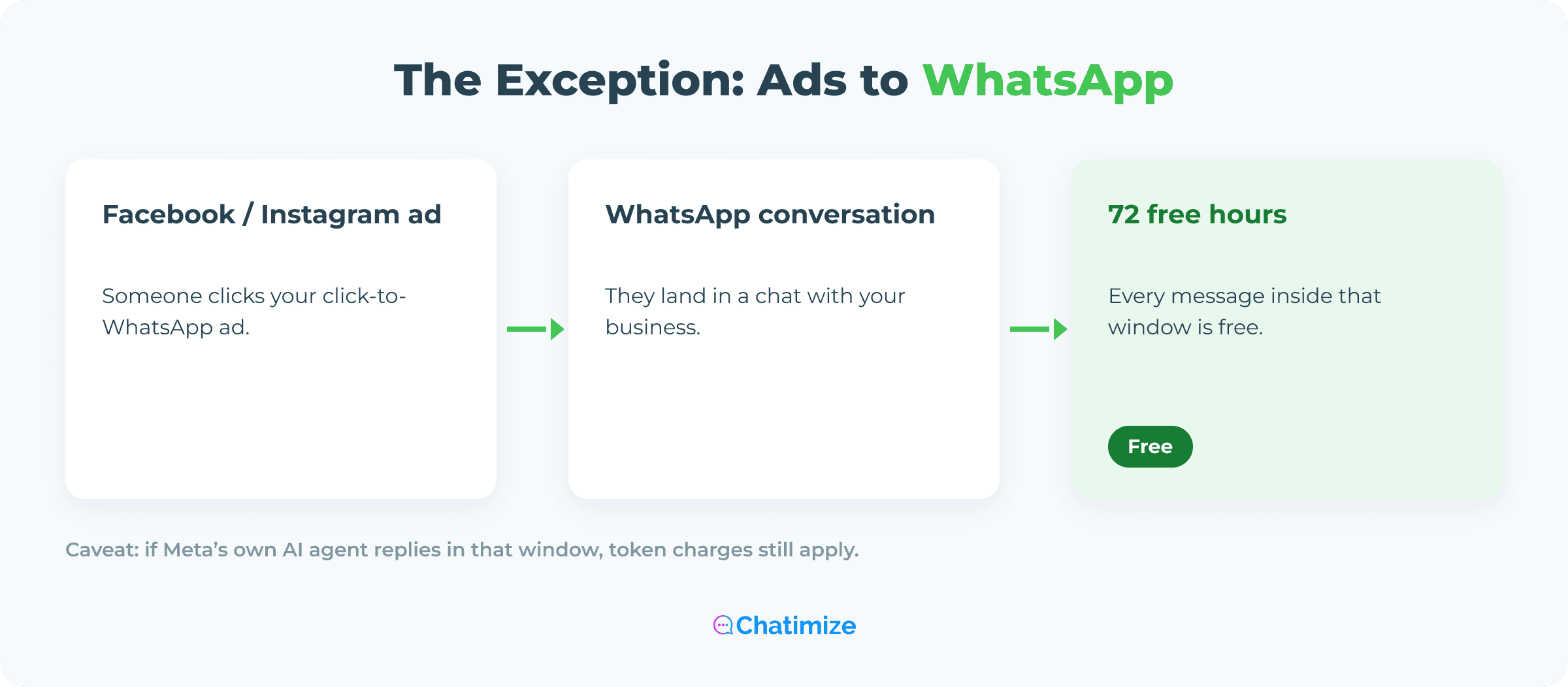
Every message you send inside those 72 hours costs you nothing, and Meta confirmed that this stays.
There is one caveat. If you let Meta’s own AI agent reply inside that window, you still pay for the tokens it uses.
So if you run ads to WhatsApp, your first 72 hours with every new lead are still free.
Pro tip: Get everything you need out of a new lead inside those 72 hours. Ask your qualifying questions, book the call, and send your follow-ups while the window is still open.
What should you do now?
So, what should you do now? Here’s a full breakdown of what I would do:
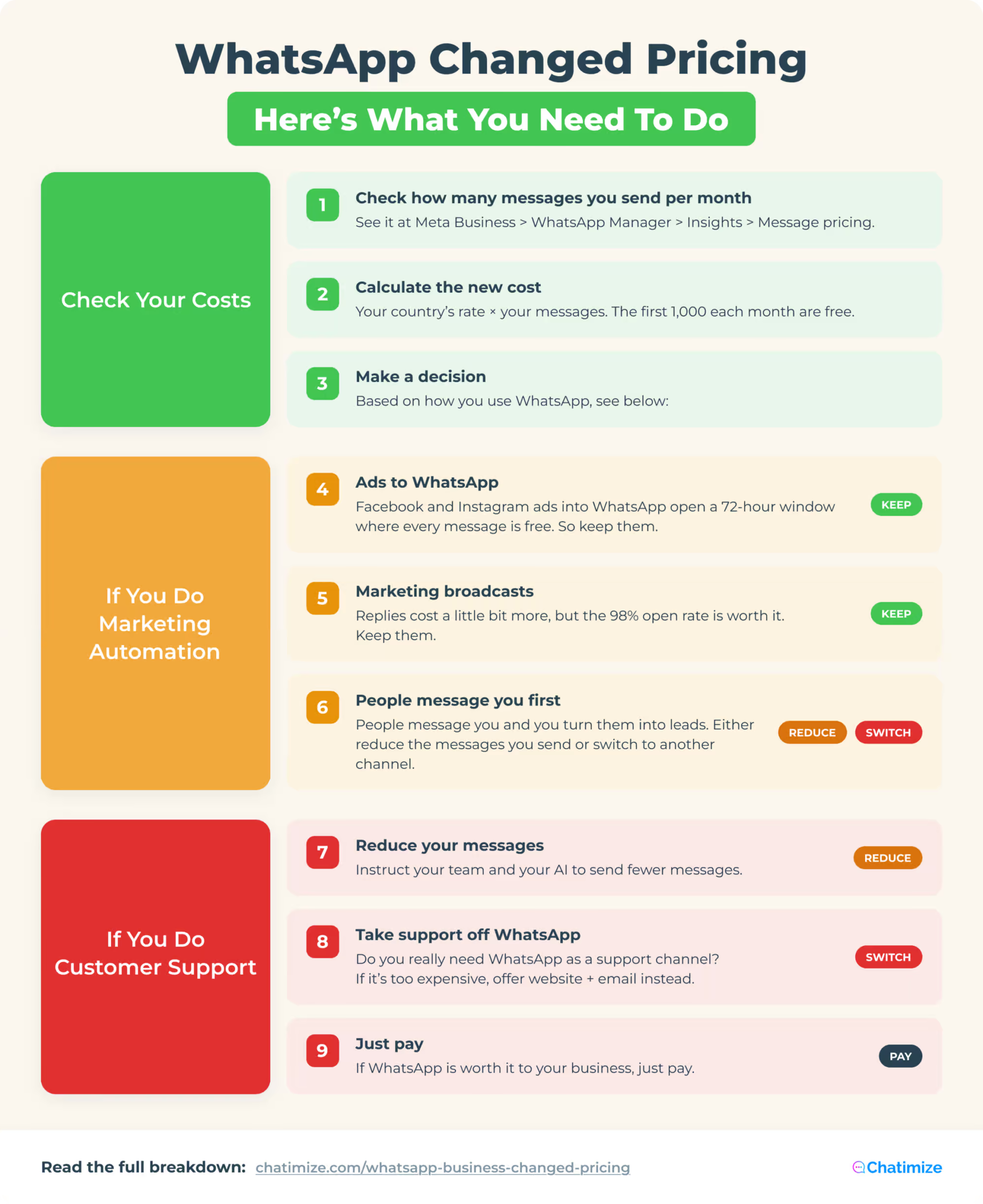
Check your costs
It starts with three steps:
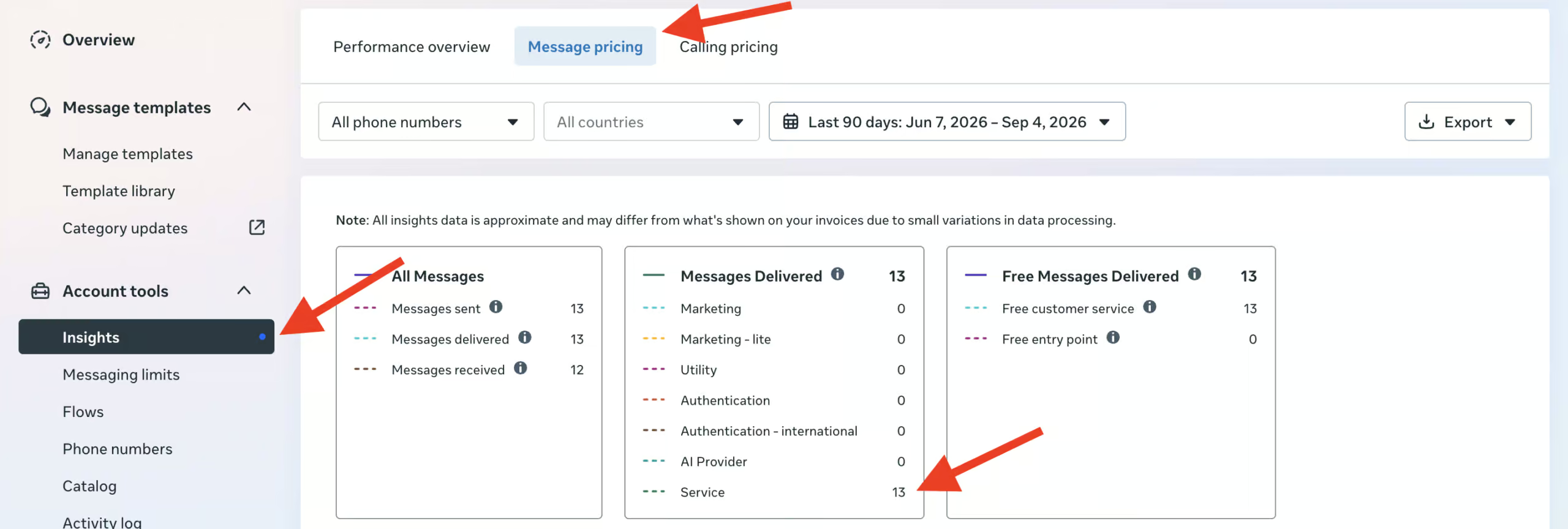
- Check how many messages you send: you find this in Meta Business, under WhatsApp Manager > Insights > Message pricing. The number you need sits next to Service:
- Calculate what you will pay: look up your country’s rate and multiply it by the messages you send in a month, minus the first 1,000.
- Make a decision: what that decision looks like depends on whether you use WhatsApp for marketing or for support.
If you use WhatsApp for marketing
There are three situations here, and in two of them I would change nothing.
If you run Facebook or Instagram ads to WhatsApp, keep doing it. Those ads open the 72-hour free window, so almost nothing changes for you.
What matters is that you get everything you want out of that lead inside the first 72 hours.
Marketing broadcasts are worth keeping too. Replies to your broadcast cost a bit more now, but with a 98% open rate, they still earn their money back.
The third situation is people who message you first and you turn them into leads. There I would cut the number of messages you send, and if WhatsApp is not essential for that conversation, move it to another channel.
If you use WhatsApp for customer support
This is where it hurts the most, because every single reply now costs money. Here is what I would do, in this order.
Start by sending fewer messages. If you use AI or automation, tell your AI to answer in one longer message instead of three short ones.
Yes, that feels a bit more robotic. But your costs drop with every message you do not send, and the same goes for your team: one reply instead of five.
The next question is whether you need WhatsApp for support at all. In a lot of countries it is the number one app, so it is genuinely useful.
But if it costs you hundreds of dollars a month, you could also consider offering support on free channels, like your website and email.
And if WhatsApp is still worth it for your business, just pay. That is a completely fine answer.
What I think of this change
Honestly, I did not see this coming.
But it does make sense. WhatsApp has been the number one messaging app in a lot of countries for years, it is free for the people using it, and Meta has to make money somewhere.
What I do not like is how heavy the pricing is in some countries. Germany pays 5.5 cents per message and the Netherlands 5 cents, and even Indonesia pays 2.5 cents.
And you get nothing extra for that money. You are paying to talk to your own customers.
So here is my prediction. For marketing, most businesses will simply pay, because it is worth it.
I actually think more companies should use WhatsApp marketing, since it is still an untapped channel and the results you can get are insane.
For customer support, I think some businesses will leave WhatsApp. And that makes sense too, because for them it will just cost too much.
What to do next
WhatsApp is getting more expensive, but it is still the channel with the highest open rate you can get.
So the goal is not to leave WhatsApp. The goal is to get more out of every message you send.
The best way to do that is with a chatbot that qualifies people, answers the common questions, and does it in as few messages as possible.
Here is my step-by-step guide to create a WhatsApp bot for free.