If someone files an insurance claim at 9 PM, they don’t want to wait until the next business day for an answer.
They want an update immediately.
That’s why insurance chatbots are becoming more common across insurance companies, from small agencies to large providers.
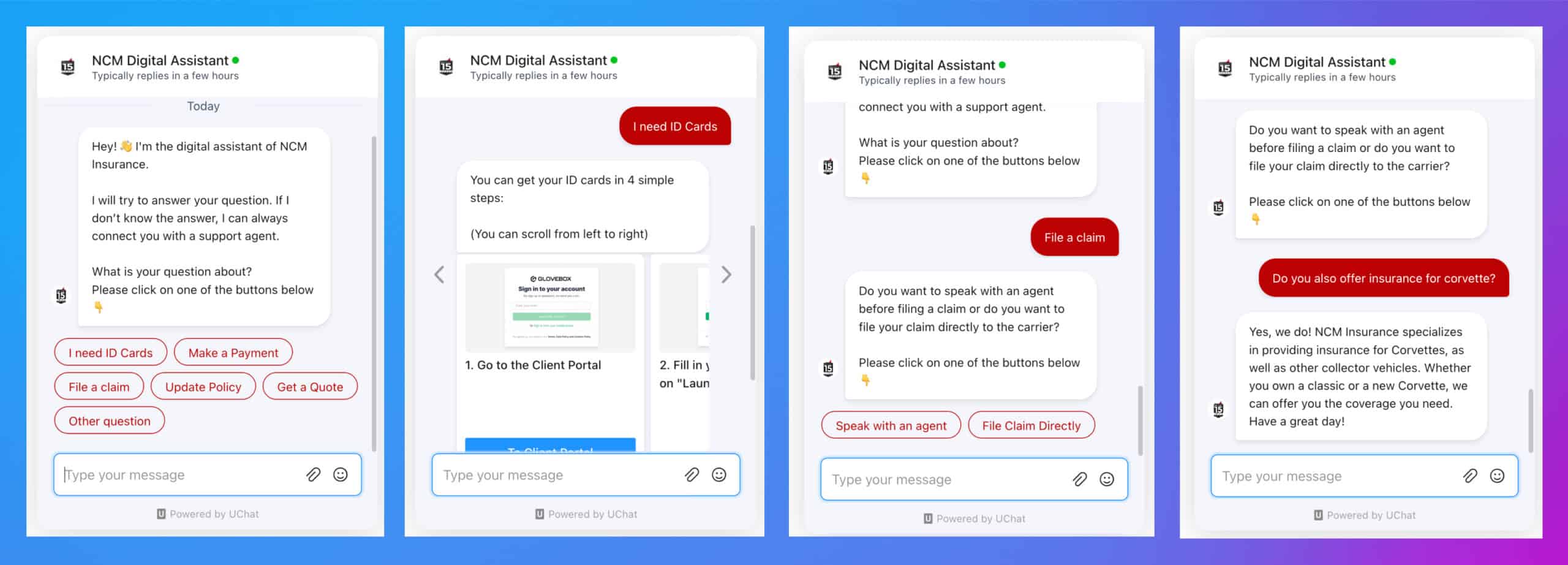
In fact, I recently built an insurance chatbot for NCM Insurance, a company that covers high-value collector vehicles. It helps customers handle payments, ID cards, claims, and policy updates without calling support.
And research shows that almost 70% of customers prefer chatbots, because they get an answer right away.
But what exactly is an insurance chatbot?
How does it actually work behind the scenes? And which type makes sense for your insurance business?
That’s exactly what I’ll break down in this guide.
Here’s what you’ll learn:
- What an insurance chatbot really is
- How insurance AI chatbots work
- Real-life examples of insurance chatbot use cases
- The 4 different types of insurance chatbots
- How to choose the right chatbot type for your situation
Let’s get started!
What Is an Insurance Chatbot?
An insurance chatbot is software that automatically responds to customer messages for an insurance company.
Instead of a human agent answering every question, the chatbot handles conversations instantly.
That can include:
- Answering policy coverage questions
- Providing claim status updates
- Sending payment reminders
- Collecting customer details
- Routing conversations to the right department
Put simply, it’s a digital assistant for your insurance business.
It works across different channels, such as:
- Your website
- Mobile apps
- Facebook Messenger
- Even SMS in some cases
From the customer’s perspective, it feels like a normal conversation. From the insurance company’s side, it reduces manual support work and speeds up response times.
And unlike human agents, insurance chatbots:
- Work 24/7
- Respond instantly
- Handle hundreds of conversations at the same time
That’s why more insurers are using them as a first line of assistance, especially for repetitive, high-volume questions.
But knowing what an insurance chatbot is is only part of the story.
To really understand their value, you need to see how they actually work in practice.
How Insurance Chatbots Work
At their core, insurance chatbots do one simple thing:
They respond instantly when a customer sends a message.
What happens between the question and the reply depends on the setup. But the overall process usually follows a clear flow.
It looks like this:
- A customer asks a question
- The chatbot understands the request
- The chatbot pulls information or triggers an action
- The chatbot sends a response or escalates to a human agent
Let’s make that more concrete.
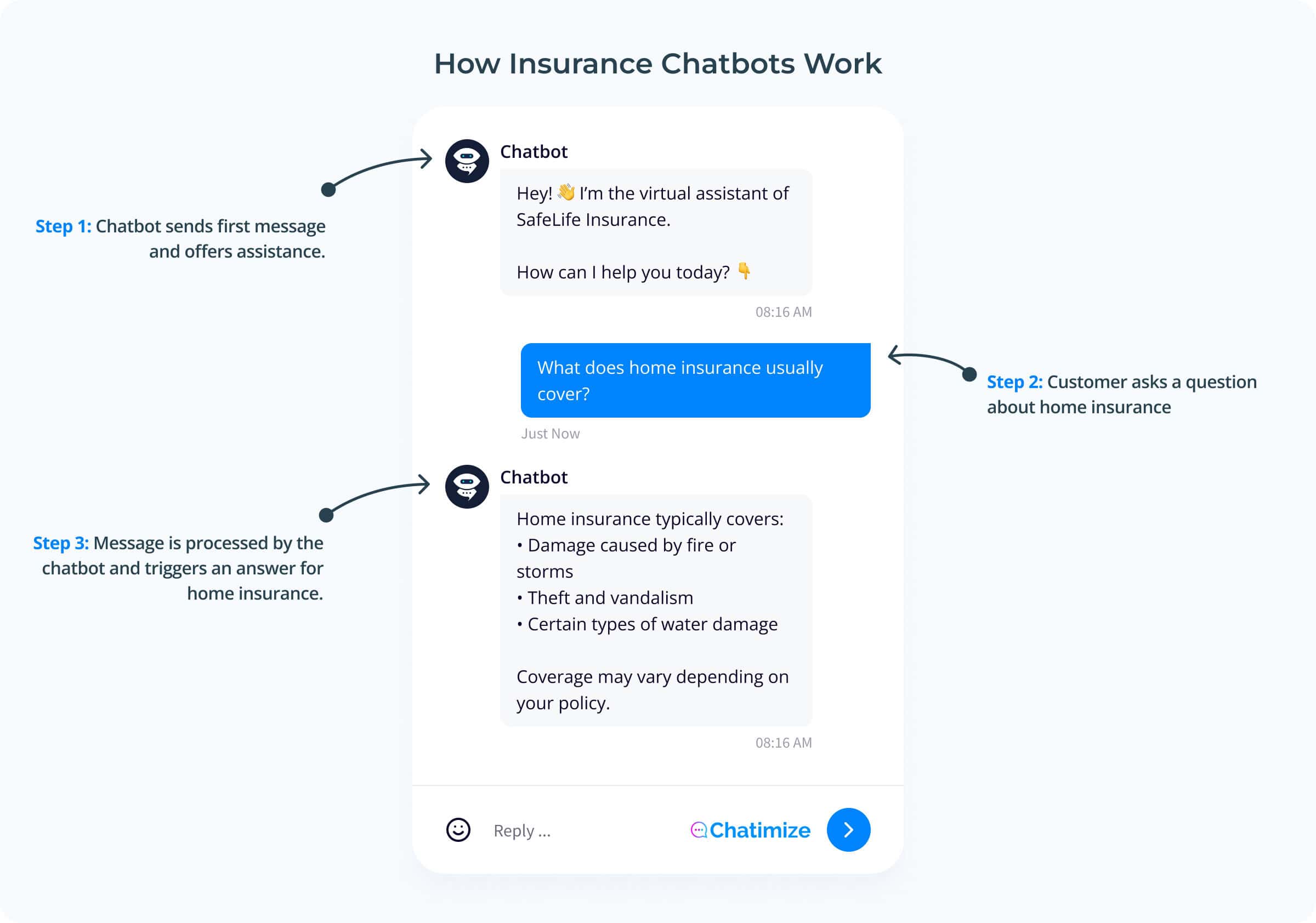
Imagine someone types:
“What does home insurance usually cover?”
Here’s what happens, step by step:
- The customer starts a conversation, and the chatbot sends a welcome message
- The customer asks about home insurance
- The chatbot processes the message and sends a response
If the request is simple, the chatbot handles it completely.
If it’s more complex, for example, a dispute about claim approval, then the chatbot can hand off the conversation to a human agent.
Insurance chatbots aren’t meant to replace human agents entirely. They handle repetitive, structured interactions first. Then they escalate when careful judgment or empathy is needed.
This balance makes chatbots practical in the insurance industry.
Now let’s look at how this works in real-life situations.
Real-Life Insurance Chatbot Examples
NCM Insurance specializes in insurance for high-value collector vehicles (like Corvettes and Porsches). And they had a common problem:
They got a lot of calls about simple tasks, like ID cards, payments, claims, policy updates. And it pulled attention away from their core operations.
At the same time, they had just launched a new customer portal where customers could do those tasks themselves.
But people weren’t using it.
So they hired me to build them a chatbot that needed to do two things:
- Reduce incoming calls
- Guide customers into the portal so they can self-serve
When someone opens the chat, the bot immediately shows a clear set of options (instead of forcing people to type long messages). Each option triggers a rule-based flow that walks the customer through the exact steps:
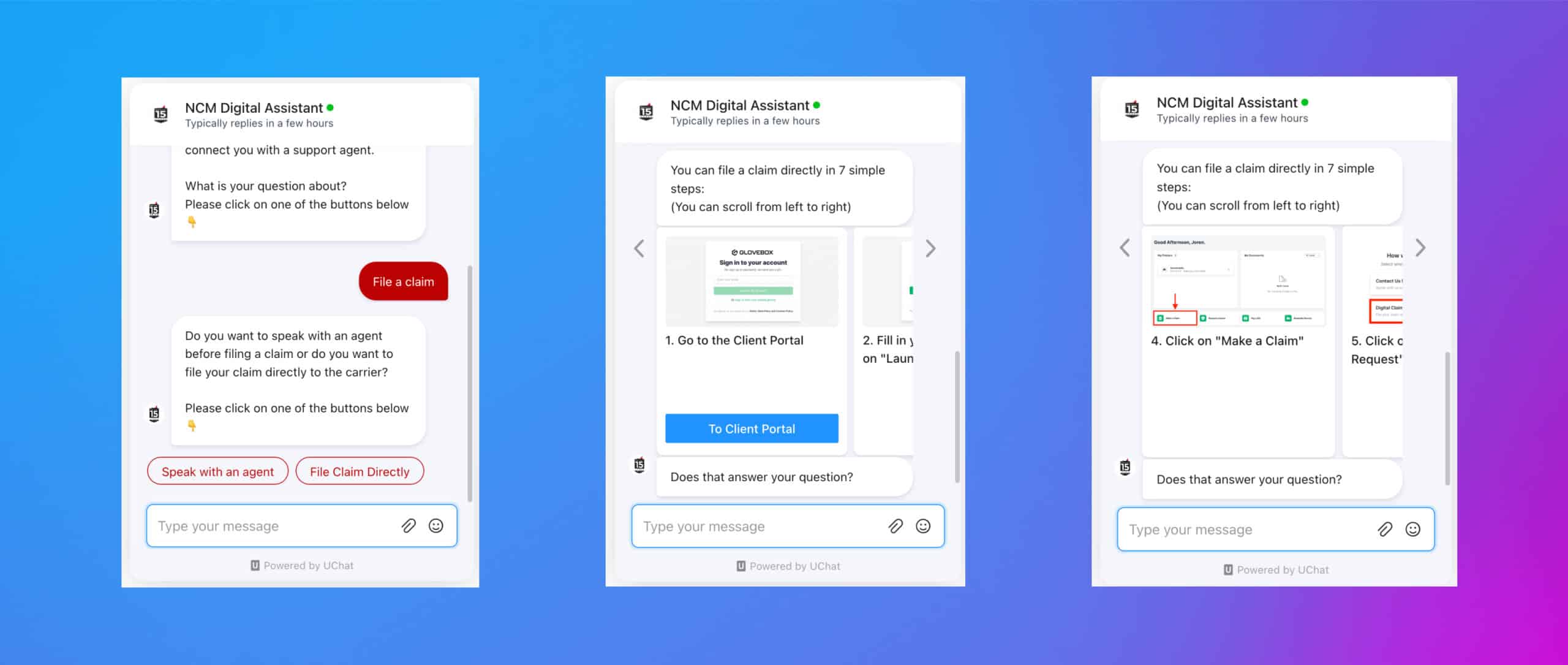
For example, if someone clicks “File a claim”, the bot asks one key question: do you want to speak with an agent, or file directly with the carrier?
If they choose to file directly, the chatbot shows a step-by-step walkthrough inside the client portal. That way, the customer can complete the claim without calling:
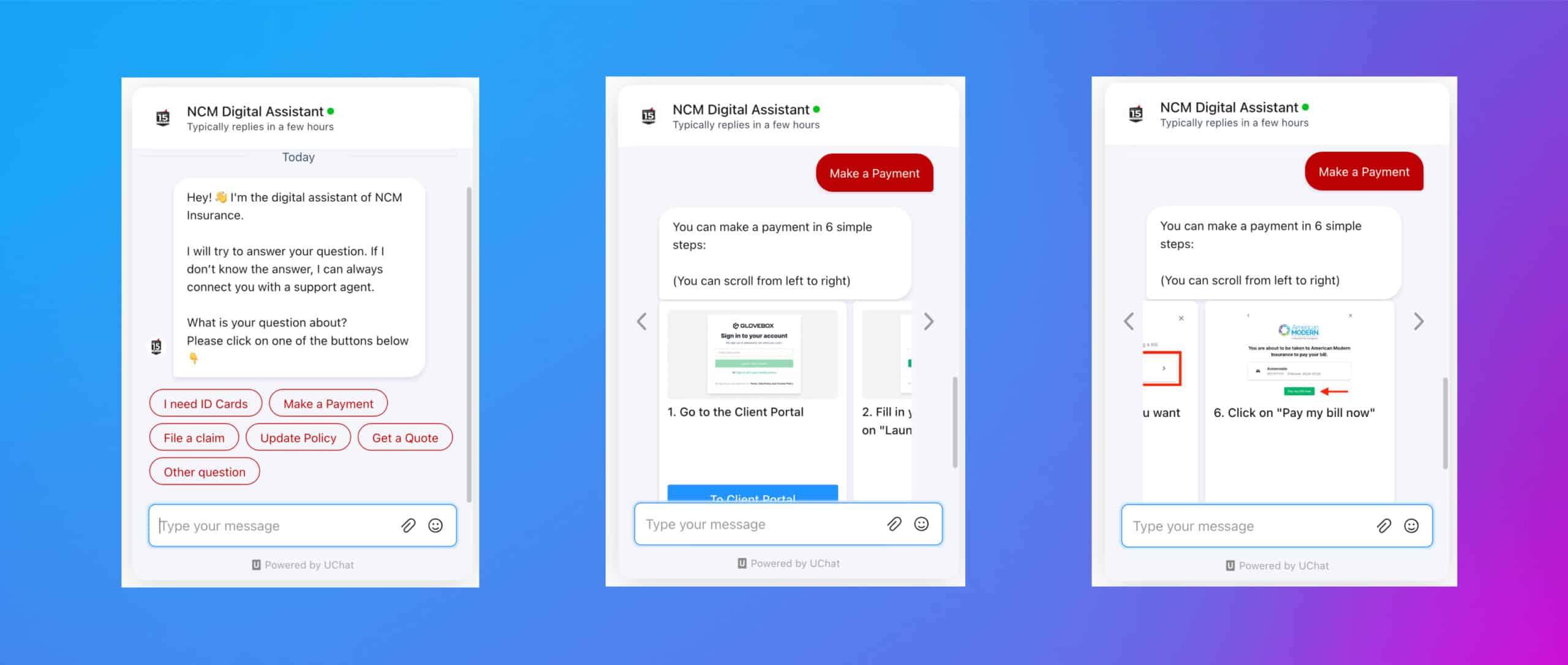
The payment flow works the same way. Click “Make a Payment”, and the chatbot provides a simple walkthrough so customers can pay in the portal:
The chatbot can also help users with policy changes. It guides them through updates, like deleting a vehicle, by first collecting the right details:
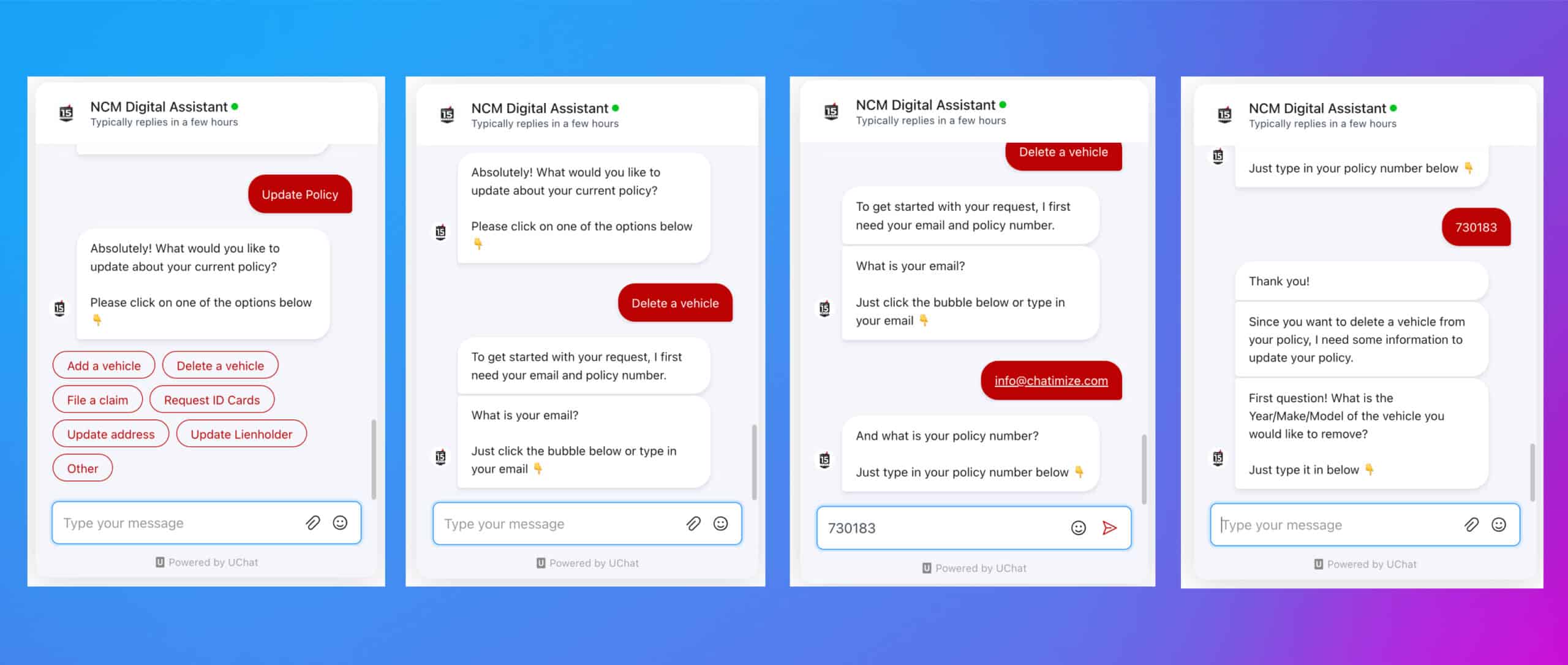
I should mention that this is an example of a Hybrid chatbot. It uses a combination of rules and AI to answer questions.
It’s rule-based by default (for control and compliance). But when someone asks a question outside the flows, the AI steps in as a backup and answers based on the website content.
We will explain the exact chatbot types in a later section.
For now, know that the chatbot acts like a digital front desk and a self-service guide. And customers are not forced to call.
Common Insurance Chatbot Use Cases
Now that we’ve seen practical examples, let’s group them into the main categories insurers use today.
Most insurance chatbot use cases fall into six core areas. These cover support, claims, payments, and sales.
Let’s go over them one by one.
Customer Support Automation
Customer support is the most common use case for an insurance chatbot.
Insurance companies receive a high volume of repetitive questions every day, about:
- Coverage
- Deductibles
- Documents
- Claims
- Payments
- Policy changes
Many of these questions are informational. People want to know what their policy covers, whether a specific incident is included, what their deductible is, or how to update their details.
A chatbot can handle these questions instantly by replying with clear answers (or guiding the customer to the right place in the portal).
Claims are another big part of support.
Chatbots can guide customers step by step through claim submission and collect structured information such as:
- Incident date
- Description
- Photos or documentation
- Contact details
Once submitted, the same chatbot can provide automated claim status updates. That improves transparency for customers and reduces manual claim intake work for the insurer.
And if something gets complicated, the chatbot can forward the conversation to an agent with all the context included.
This reduces wait times and lowers the overall support workload.
Payment Reminders and Renewals
Insurance chatbots can proactively prevent missed payments and policy lapses.
They can:
- Send automated reminders before renewal dates
- Notify customers about outstanding premiums
- Guide them through payment steps
This is especially effective on messaging channels like SMS or WhatsApp chatbots, where response rates are much higher than email.
It results in fewer lapses and less manual follow-up from staff.
Lead Qualification for Insurance Quotes
Apart from support, insurance chatbots are also powerful for lead generation.
When someone visits a website looking for a quote, the chatbot can:
- Ask qualifying questions
- Collect contact details
- Determine coverage needs
- Route high-intent leads to a sales agent
Instead of a long form, the visitor has a guided conversation.
This improves engagement and filters serious prospects.
Appointment Scheduling with Agents
Some insurance matters require human interaction.
Chatbots can schedule appointments directly within the conversation by:
- Checking agent availability
- Offering time slots
- Sending confirmation messages
This reduces back-and-forth emails and makes sure customers reach the right person faster.
4 Types of Insurance Chatbots
How chatbots work is different depending on the chatbot type.
The biggest difference between chatbot types is how they decide what to reply. They also differ in whether they can take actions or just answer questions.
There are four main types of insurance chatbots, ranging from simple rule-based systems to more advanced AI agents.
Let’s go through them one by one, from basic to more advanced.
1. Rule-Based Insurance Chatbots
Rule-based chatbots are the simplest type of insurance chatbot.
Like their name suggests, they follow predefined rules. When a customer clicks a button or uses certain keywords, the chatbot sends a specific response.
Here’s what that looks like in practice:
- Customer: “What is included in my travel insurance?”
- Chatbot gives a predefined response because the word “travel insurance” was said
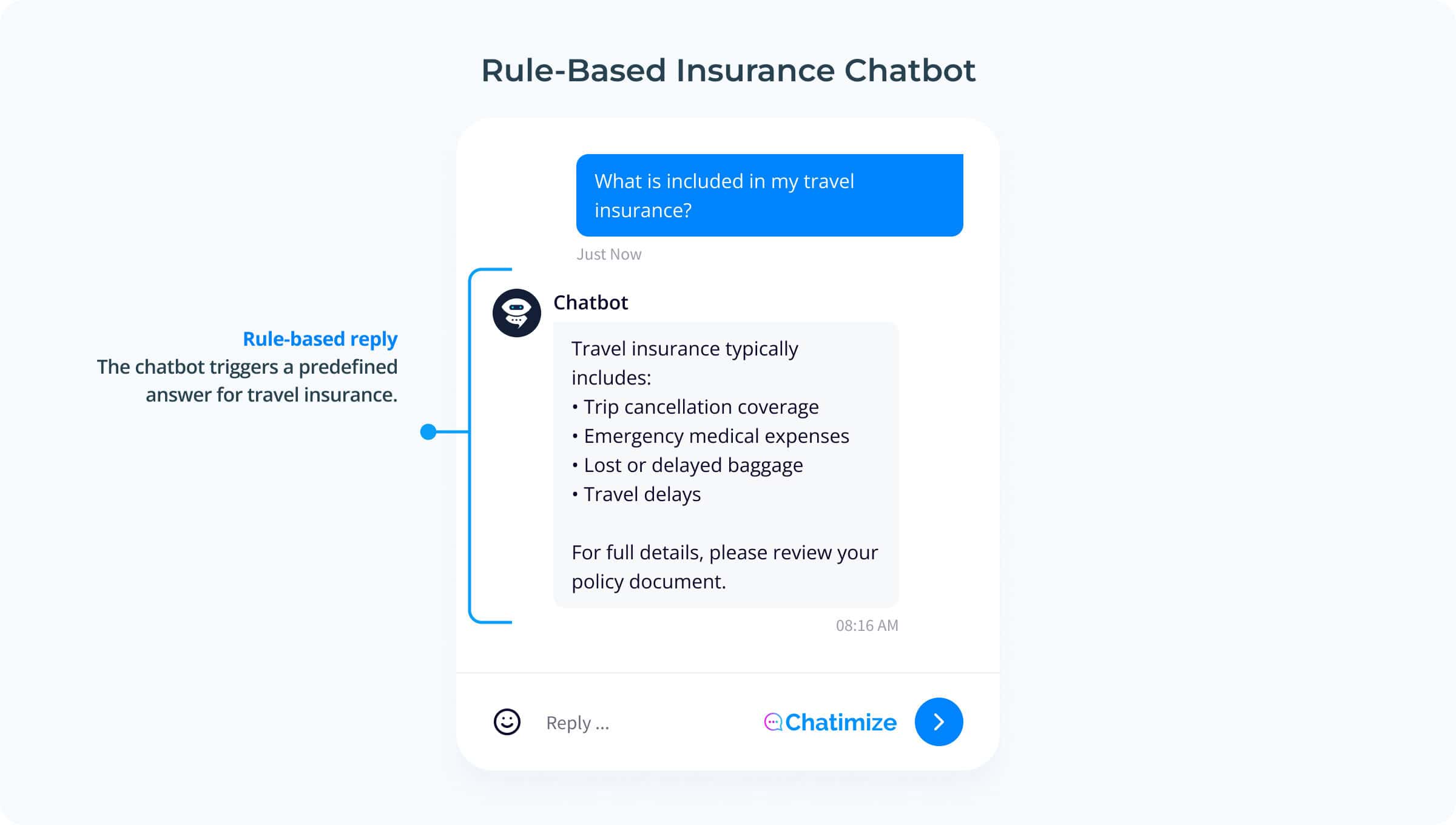
Everything is predictable and controlled.
That’s why rule-based chatbots are often used in compliance-heavy environments like insurance. Companies know exactly what the chatbot will say and how conversations will flow.
Best for:
- Policy information
- Basic FAQs
- Simple customer service tasks
- Predictable, structured workflows
Limitations:
- Breaks when users ask something outside the predefined flow
- Requires you to build and maintain paths for every scenario
Rule-based chatbots are reliable, but limited.
2. AI Insurance Chatbots
AI insurance chatbots are more flexible. They feel more human.
Instead of following fixed rules, they try to understand what the customer actually means when they send a message. They can be trained on website or policy documents, and can auto answer questions about that.
For example:
- Customer: “My flight was cancelled because of bad weather. Can I claim compensation?”
- Chatbot understands the question and searches for the relevant information in documents or on the website
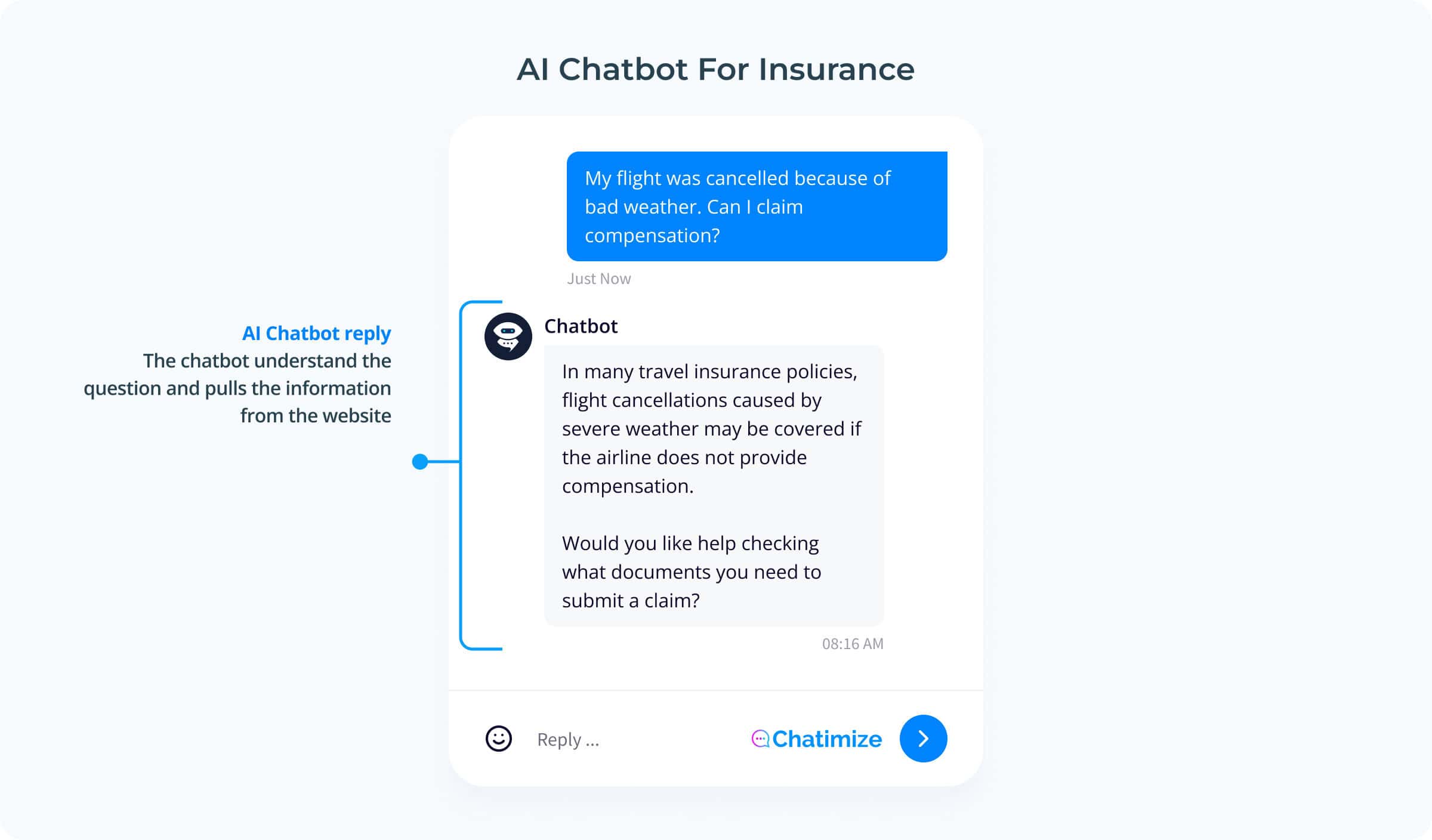
An AI chatbot looks at the message to understand its intent. Then, it searches policy documents or knowledge bases for the best answer.
This allows insurers to handle a much wider range of questions automatically.
Best for:
- Customer support
- Policy explanations
- Knowledge base questions
Limitations:
- They typically answer questions but don’t perform complex actions
3. AI Agents (Modern Approach)
AI agents do everything AI chatbots can do, and add actions on top.
They don’t just respond with information. They can connect to internal systems and get live customer data or trigger actions in your insurance software.
For example, an AI agent can:
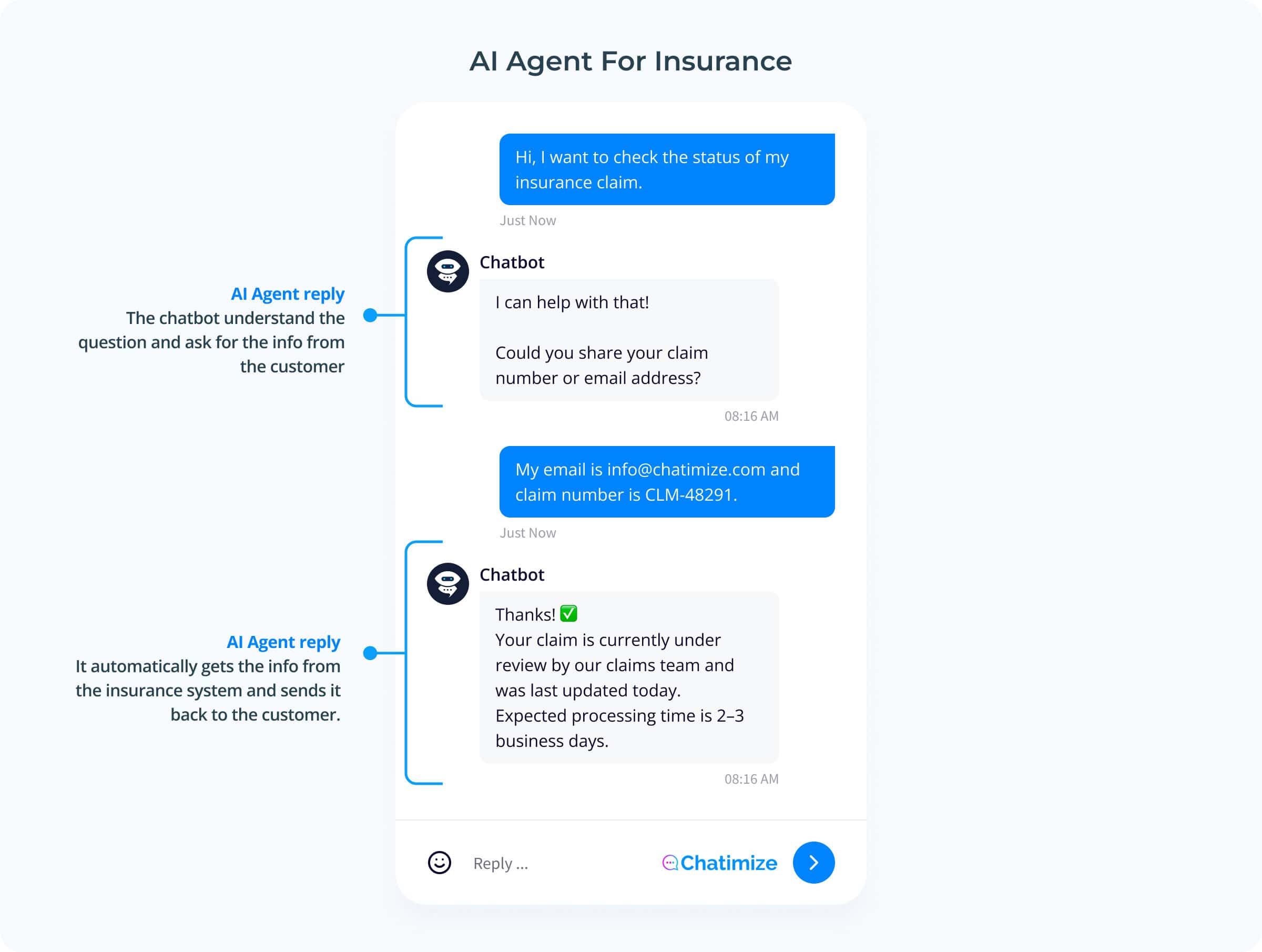
- Look up insurance claim status
- Edit customer details
- Take information from a CRM or database
Here’s what that looks like in practice:
Best for:
- Claim status lookups
- Policy lookups and account support
- Insurers that want true self-service (with system integrations)
But these setups are more complex to implement than a basic chatbot.
4. Hybrid Insurance Chatbots
In reality, most insurance companies don’t rely on just one approach. Instead, they use hybrid chatbots that combine multiple chatbot types.
That’s because some questions are very predictable and simple. Some need AI. And others require taking action.
For example:
- Simple, predictable questions → handled by rule-based flows
- Knowledge questions → handled by insurance AI chatbots
- Action requests → handled by AI agents connected to internal systems
For example, a chatbot may first answer with a rule-based reply. Then later, an AI agent can take over if it’s needed.
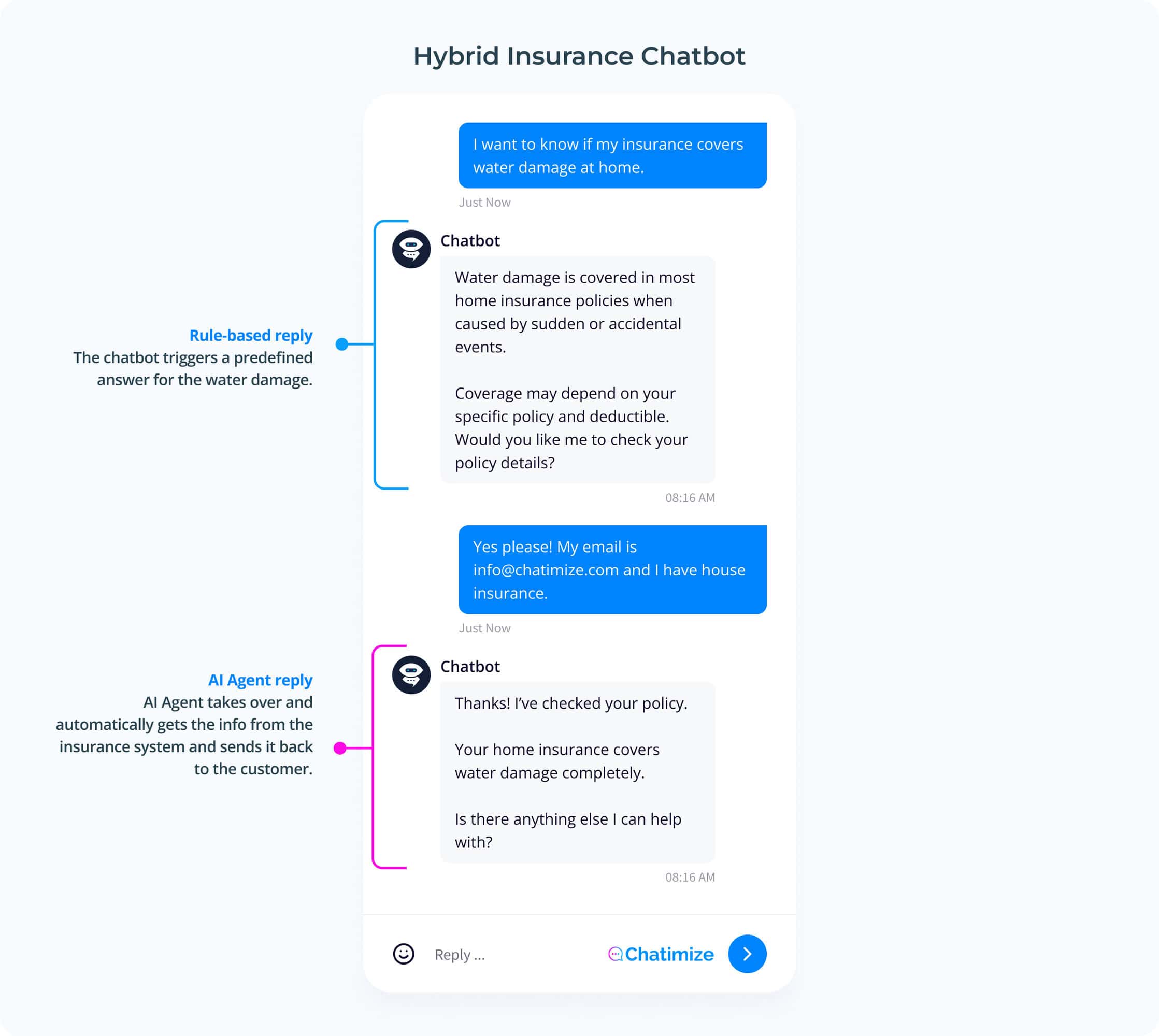
This setup balances control, flexibility, and automation. It allows insurers to keep sensitive processes structured while still offering more natural conversations for customers.
Best for:
- Most real-world insurance businesses
- Companies scaling chatbot automation
- Environments where compliance and flexibility both matter
For most insurers, a hybrid setup provides the safest and most scalable approach.
Which Insurance Chatbot Type Is Best for You?
If you’re not sure which insurance chatbot type makes sense for your situation, here’s a simple way to think about it.
Ask yourself these questions, one by one. The best setup depends on your answers:
- Just need predictable FAQs and compliance-friendly flows? → Rule-based insurance chatbot
- Need to answer a wide range of customer questions in plain language? → AI insurance chatbot
- Need the chatbot to look up policies, check claim status, or trigger actions in your systems? → AI agent
- Need a mix of control, flexibility, and automation? → Hybrid insurance chatbot
The safest approach for most insurers is to start simple, then scale up as your automation goals grow.
Your Next Steps
That’s it! You now understand how insurance chatbots work and the four main types.
The next step is to choose the setup perfect for your business and build your first chatbot.
To get started quickly, I have a simple step-by-step guide that teaches you how to create an AI chatbot in under 10 minutes.
Click the link below to learn how: