When you create chat automations in Manychat, Manychat offers a flow builder. Each automation has a trigger and blocks. The blocks define the contents of the automation.
Adding blocks is super easy, you can just drag and drop them in the flow builder:

To keep your automations structured, you can also divide these into folders:

Additionally, Manychat has some nice features that make it even easier to use. For example, click on Auto-Arrange Steps. It will arrange all the steps in your automation. Or you can you use Ctrl+C/Ctrl+V to copy and paste elements.
Like Manychat, Chatfuel also has a Flow Builder for chat automations. You can just drag and drop elements in the flow builder, which is super easy to use:

Chatfuel has similar cool features. It can copy/paste and auto-organize blocks.
Also, both chatbot builders let you test your chat automations before going live.
Both chatbot platforms are extremely easy to use. When using them I only found three differences:
- Manychat’s flow builder is just a bit easier to use, has a smoother experience.
- Chatfuel’s flow builder is slow with larger automations.
- With Chatfuel, you cannot duplicate chatbot flows across channels
 |  | |
|---|---|---|
Ease of use How easy it is to build and change things once you’re set up? On a scale of 1 to 5. | 5 | 4 |
| Setup difficultyHow much technical work it takes to get going. | Easy | Easy |
| Average setup timeHow long until your first bot or AI agent is live. | 1 hour | 2 hours |
| Set up with AIDescribe what you want in a chat, and an AI builds the bot or agent for you. | ||
| Test before going liveYou can try the bot or agent yourself before customers see it. |
Both Manychat and Chatfuel provide many chatbot elements to build your chatbot.
You can collect User Input and create conditional branches. It’s great for creating personalized chatbots. Plus, you can start other automations (best for scalability).
| |
|---|
In Manychat, you can see all the contacts that talked to your chatbot in one overview:

When you click on one contact, you can see their custom fields and tags. Clicking on “Start chat” shows their entire chat history on all channels:

You can add unlimited custom fields and tags to your contacts. Custom fields are used to store specific information about someone, such as their interests, email address or name. Tags can be used to segment your contacts into different buckets, such as “Qualified” or “Customer”.
Additionally, you can also create segments based on a combination of fields and tags.
Chatfuel offers the same functionalities. So you can see all the contacts of your chatbot in the People tab:

When you click on one of the users, you can see all the user information for that specific person:

Additionally, you can also create custom segments in the People tab by clicking on the Add Segment button. This automatically saves the current filters to a new segment. Then, you can use this segment in your Chatfuel automations, such as when sending a broadcast:

| |
|---|
Both Manychat and Chatfuel provide keyword-recognition.
This means you can auto-reply to questions with a certain keyword.
In Manychat, this is called the Keyword trigger:

And in Chatfuel, you can create Keyword groups:

Besides that Manychat offers an AI Add-On.
This add-on includes four extra features:
- AI Intents
- AI Step
- AI Flow Builder Assistant
- AI Text Improver
With AI Intents, you can not only reply to certain keywords, but understand the intent of the user. So if someone types in a question and it matches with the intent, you can automatically reply to it:

This can save you a lot of time, because you don’t have to manually enter all the keywords you want to match. You can just enter the intent and Manychat AI can automatically reply to it.
But I think the most promising feature is the AI Step. With the AI step, you can create your own AI Lead generation assistants with natural language.
With the AI step, you can let the AI handle the conversation for you in a number of steps. And then you can tell the AI:
- What it needs to do at every step
- Whether it needs to collect information
- And if it needs to collect information, to what Manychat fields these need to be saved

And the AI step can also take into account the context of your business. So you can give extra business information and use that information during the conversation.
Furthermore, Manychat provides the AI Flow Builder Assistant. With this assistant, you only have to answer some questions. Then, it will create an automation for you:

And lastly, Manychat also has the AI Text Improver. It can rewrite any text for a different goal, change the tone or translate it to another language:

Chatfuel also has two extra AI features: direct integration with ChatGPT and AI Agents.
With the ChatGPPT integration, you can determine to what intents Chatfuel will reply and how the AI needs to answer:

With this integration, you can also determine how many messages ChatGPT should remember.
And Chatfuel provides pre-configured AI Agents.
AI Agents are similar to the ChatGPT integration, but are predetermined by Chatfuel and can do entire tasks on their own.
You can use the 1st-line customer support agent to automatically answer customer questions, for example.
What is great about the ChatGPT and AI agent block is that you can also tell ChatGPT when it should handover the conversation back to a Chatfuel flow. For example, if a user is angry, you can directly send them to live chat:

So both platforms have AI features you can use to create better chatbots!
| | |
|---|---|---|
| Build an AI agentYou can build an AI agent that replies on its own. | ||
| Train the AI on your contentThe AI learns from your website, documents or files. | ||
| AI rulesTell the AI what it may and may not do, and which steps to follow. Also called guidance, guardrails or procedures. | ||
| Let the AI perform actionsThe AI can do things in other tools, like book a meeting or update your CRM. | ||
| Connect the AI to MCP serversThe AI agent can use any tool that has an MCP server, without a custom setup per tool. |
Manychat has a built-in live chat that is called Inbox. By using the Inbox, you can hand over the conversation from your chatbot to one of your customer support agents:

Additionally, Manychat also has an iOS and Android app, allowing you to answer to questions on your phone.
In addition, Manychat also has a more advanced version of their Inbox: Inbox Pro. This comes with extra features, such as:
- Creating groups of team members
- Auto-assinging conversations based on rules
- And agent chat analytics
If we look at the live chat of Chatfuel, this one is more limited.
Just like with Manychat, Chatfuel also has a built-in Live Chat feature:

And this also comes with an iOS and Android App, which is great.
They both have great live chat. But, Manychat lets you set up automated rules for assigning conversations. Chatfuel doesn’t.
| | |
|---|---|---|
| Hand over to a humanYour team can take over a conversation from the bot or AI, in an inbox inside the platform. | ||
| AI copilotAI helps your team inside the inbox after a handover: it summarises the chat, tells you the customer’s mood, and suggests replies. | ||
| Auto-assignment rulesConversations go to the right teammate automatically. | ||
| SLAsSet response-time targets and get alerted when a conversation is about to miss them. | ||
| Connects to an external help deskHands conversations over to helpdesk platforms like Zendesk, Freshdesk, Intercom and similar. | ||
| Contact profilesOne profile per person with their details and chat history. | ||
| Custom fieldsAdd your own fields to a profile, like order number or budget. | ||
| Merge contacts across channelsThe same person on WhatsApp and Instagram becomes one profile. |
With Manychat, you can publish a chatbot on Facebook, Instagram, WhatsApp, Telegram, SMS and Email.
With SMS, you need to connect your ManyChat account to a Twilio account. Then, ManyChat will handle the chatbot and chat logic. Twilio will receive and send the text messages (Twilio has extra costs).
You can also merge contacts across channels using their email or phone number. For example, if someone contacts you via Facebook Messenger and later via Instagram. Manychat can see that it is the same person and merge the contacts.
Chatfuel offers fewer channels: Facebook, Instagram and WhatsApp.
Likewise, it’s not possible to merge contacts across channels.
So this is a clear win for Manychat.
| | |
|---|---|---|
| WebsiteCan you publish your chatbot on your website? | ||
| WhatsAppCan you publish your chatbot on WhatsApp? | ||
| FacebookCan you publish your chatbot on Facebook? | ||
| InstagramCan you publish your chatbot on Instagram? | ||
| TelegramCan you publish your chatbot on Telegram? | ||
| SMSCan you publish your chatbot on SMS? | ||
| EmailCan you publish your chatbot on email? | ||
| SlackCan you publish your chatbot on Slack? | ||
| WeChatCan you publish your chatbot on WeChat? |
Besides user-triggered automations, you can also start chats with your contacts.
With Manychat, you can do this by sending broadcasts & sequences.
With broadcasts, you can send mass messages to your contacts in Manychat:

Likewise, you can send a series of messages with a certain time interval by using a Sequence:
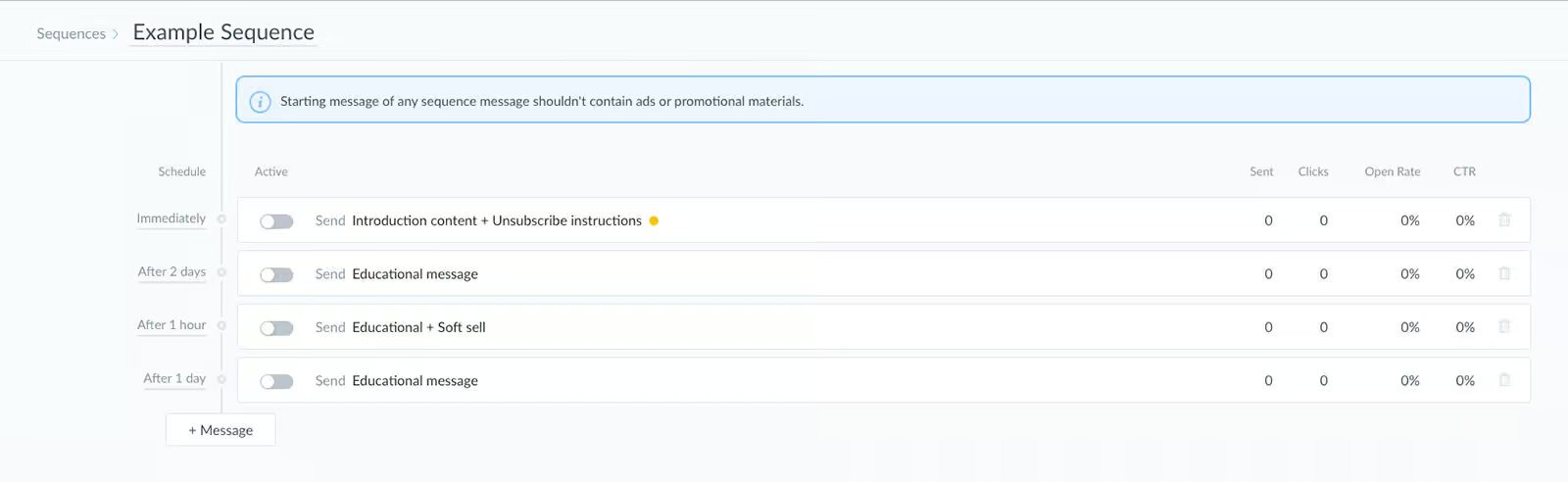
And lastly, you can also create your own Rules. With a Rule, you can automatically do an action when an event happens.
For example, when someone books an appointment, we can send them a reminder 1 day before it:

With Chatfuel, you can also send broadcasts and sequences:

Unfortunately, they don’t have the Rules feature as Manychat provides it.
So Manychat is slightly better, because it has Rules.
To drive traffic from your social channels, both platforms are great. They offer all possible ways to drive traffic to chat automations.
On Facebook, you can:
- Create Ref URLs that go to specific chat automations
- Automatically reply to Facebook Comments and start a Messenger conversation
- Send one-time notifications
- Send Recurring Notifications
- Connect a Facebook ad to your Messenger chatbot
On Instagram, you can:
- Automatically reply to Instagram comments and start conversations in Instagram DM
- Send automatic replies to people who mention your account in their Instagram story
- Connect an Instagram Ad to your Instagram chatbot
Lastly, on WhatsApp, you can send message templates to start chats.

| | |
|---|---|---|
| BroadcastsSend one message to many contacts at once. | ||
| SequencesSend a series of messages over time. | ||
| Proactive website messagesSend a visitor a message based on what they do, like 90 seconds on the pricing page. | ||
| Comment to DM on FacebookSend a DM to someone who comments on your Facebook post. | ||
| Click-to-message Facebook adsRun Facebook ads that open a chat with your bot. | ||
| Facebook Ref URLA link that opens Messenger and starts a specific flow. | ||
| Comment to DM on InstagramSend a DM to someone who comments on your Instagram post or reel. | ||
| Follow to DM on InstagramSend a DM to someone who follows you on Instagram. | ||
| Story mention reply on InstagramReply in DM when someone mentions you in their story. | ||
| WhatsApp message templatesSend approved WhatsApp templates, for broadcasts or for follow-ups outside the 24-hour window. |
Regarding integrations, Manychat and Chatfuel are equally good.
Both platforms provide direct integrations with other applications. For example, Manychat integrates with ActiveCampaign, ConvertKit, Hubspot and more.
Chatfuel provides similar integrations with Hubspot, Shopify and Google Sheets.
If that’s not enough, they both also provide direct integrations with Zapier and Make, allowing you to connect to almost any application on earth.
And lastly, you can use both of them to make API Calls in the flow builder.
The only thing that Manychat has and Chatfuel doesn’t is its own App Store.
This lets developers create their own integrations with Manychat. It currently has over 61 apps to extend Manychat’s functionality.
Integrations often end up being the deciding factor. So, it’s worth checking how ManyChat alternatives and Chatfuel alternatives handle this part of the ecosystem as well.

| | |
|---|---|---|
| Direct integrationsHow many built-in connections to other tools does it have? | 1-10 | 1-10 |
| ZapierDirect integration with Zapier, one of the largest integration platforms in the world. | ||
| MakeDirect integration with Make (formerly Integromat), one of the largest integration platforms in the world. | ||
| API CallsSend data to or get data from another tool’s API, for example inside a flow. |
When it comes to pricing, both platforms provide plans at a pretty cheap price.
Manychat’s free plan comes with:
- Basic features of the flow builder
- Some Growth Tools
- Access to 3 channels (Instagram, WhatsApp and Facebook)
You can reach up to 1,000 contacts.
If you need want all the features, you need to go with the Pro plan, which starts at $15/month and comes with 500 contacts. This plan increases with the number of contacts you have. For example, 5,000 contacts costs $45/month:

Manychat also has two Add-Ons:
- AI Add-on, which costs $29/month
- Inbox Pro, which starts at $99/month
Manychat’s Pro plan also comes with a 7-day Free Trial and a 30-Day Money-Back Guarantee.
Chatfuel on the other hand doesn’t provide a free plan, but only a free trial, which allows you to test out the platform.
If you want to head forward with Chatfuel, you can choose any of their paid plans. And they have seperate plans per channel.
For Instagram and Facebook, the Business plan is $20/month. It includes 1000 conversations.

The price of the plan increases with the number of conversations you have. For example, 2,500 conversations/month costs $45.
For WhatsApp, the Business plan starts at $49.49/month and comes with 1,000 conversations.
Just like the other plan, this price scales with the number of conversations.
And with each Chatfuel plan also comes a 30-Day Money-Back Guarantee.
So in terms of pricing, Manychat and Chatfuel do pretty well.
I would say Manychat does slightly better, because they also has a free plan and Chatfuel only has a free trial.
| | |
|---|---|---|
| Starting priceThe lowest price you can start with per month, including seat minimums (in US dollars). | $17 per month | $20 per month |
| Free planDoes the chatbot platform provide a free plan? | ||
| Free trialDoes the chatbot platform provide a free trial? | ||
| Pricing in one sentence | Free plan; paid plans start at $17/month | Starts at $20/month; free trial before you pay |
Manychat has four types of analytics:
- Manychat Insights
- Automation Analytics
- Conversion Analytics
- Agent Analytics
Manychat has an Insights dashboard that gives general insights into your Manychat account. In this dashboard, you can see how many contacts you have per channel:

And how these contacts have evolved over time:

Moreover, Manychat also has automation analytics (“Flow analytics”). For each block in your automation, you can see how many contacts it was sent to. You can also see the delivery, open, and click rates (if a message has a button):

By using these flow analytics, you can easily improve your Manychat flows for better conversion.
Also, you can add your own conversion events inside your chat automations. Then, you can see how many people reached those events in a specific period:

These conversion events are not limited to your chatbot funnels.
You can install the Manychat Pixel (like a Facebook Pixel) on your website. It will track conversions from people coming from your chatbot.
We have a complete guide on how to use ManyChat available for you.
For example, let’s say someone clicks on a button in Messenger and then converts on your website. This pixel will then track that conversion back to your Manychat account.
And if you sign up for Manychat Inbox Pro, you also get agent analytics. With these analytics, you can see how many conversations where resolved by your agents:

And you can also see how many conversations each agent resolved:

Looking at Chatfuel, they provide similar analytics as Manychat. Chatfuel also has an analytics dashboard with the number of total users:

The user activity per day:

And the most important sources of traffic for your chatbot:

Besides this, it also provides analytics on the most popular blocks and buttons in your chatbot.
And just like Manychat, it also has flow analytics.
For each message in your chatbot flows, you can see the delivery rate, seen rate and click rate:

Likewise, you can see the same data for all the sequences and broadcasts in your Chatfuel account (also possible with Manychat):

But they don’t provide conversion event tracking or a Manychat pixel. Instead, they offer an overview of all the questions your chatbot couldn’t answer:

This allows you to quickly improve the answers of your chatbot and create additional flow, which is great.
So all in all, what analytics you like more depends where you want to focus on.
They both provide a dashboard and flow analytics, which is great. But the difference is in marketing and customer support. Manychat focuses more on marketing and conversion events. Chatfuel’s analytics are more focused on improving the answers of your chatbot.
| | |
|---|---|---|
| DashboardAn overview of conversations and contacts. | ||
| Ask AI about your dataAsk questions about your analytics in a chat and get the answer from an AI. | ||
| Flow analyticsSee how people move through each flow and where they drop off. | ||
| AI Resolution rateHow many conversations the chatbot resolved on its own, and how often it had to fall back or hand over. | ||
| Knowledge gapsShows questions the AI couldn’t answer, so you know what to add to its knowledge. Also called suggestions. | ||
| Conversion trackingTracks sales, bookings or sign-ups that come from conversations. | ||
| Team performanceResponse times and workload per teammate. | ||
| Custom reportsBuild your own reports or dashboards. |
Both platforms provide many templates that you can use to get started with creating your chatbots.
Manychat provides 35 templates, whereas Chatfuel has 22 templates to get you started with.
With both platforms, you can also create these templates and share these with others.
| |
|---|
Manychat and Chatfuel have a lot of tutorials and documentation on their website to help you with using their platform.
Manychat offers customer support via a ticketing system, while Chatfuel does so via Live Chat.
Overall, the customer support of Chatfuel is also better. Because with Chatfuel you often get a response back within a day (often way quicker!).
With Manychat, it’s common to get a response after weeks. This has been noted in their community and on review sites.
Manychat, on the other hand, has a larger active community (120K+ on Facebook). Many enthusiasts there are willing to help you.
| | |
|---|---|---|
| Support qualityHow fast and helpful support was when we tested it. 5: a human replies in live chat within an hour, plus good docs. 4: a human replies the same day. 3: email only, reply within 1–2 days. 2: slow, or only an AI bot. 1: no reply. | 2 | 4 |