If you’ve ever asked a question on a website, WhatsApp, or an app and received an answer in seconds, you’ve used a chatbot.
And chances are, you didn’t even think twice about it.
That instant reply has quietly become the norm. In fact, research shows that nearly 70% of customers prefer chatbots, mainly because they don’t have to wait around for an answer.
But what actually happens behind the scenes?
How does a chatbot understand what you’re asking? And how does it know what to reply?
That’s exactly what we’ll break down in this guide.
Here’s what you’ll learn:
- What chatbots really are (in plain English)
- How chatbots work in 2026
- The 4 main types of chatbots — and how they differ
- Which chatbot type makes sense for your situation
Let’s dive in!
What Is a Chatbot?
A chatbot is a piece of software that can automatically respond to messages from users.
Instead of a human replying to every single question, the chatbot handles those conversations for you.
That’s what chatbot automation is all about.
And unlike humans, chatbots don’t need breaks. They work 24/7 and can talk to hundreds — or even thousands — of people at the same time.
To make this more concrete, imagine building a WhatsApp chatbot for an online store. It can:
- Instantly reply to common customer questions
- Send order confirmations and shipping updates
- Automatically broadcast new promotions or deals
Here’s a real-world example. This is how My Jewellery uses a chatbot to automatically reply to customer questions on WhatsApp.

From the customer’s perspective, it feels like a conversation. From the business side, it’s automation doing the heavy lifting.
How Do Chatbots Work?
At their core, chatbots do one thing really well: they respond instantly when someone sends a message.
What happens between the question and the reply depends on the type of chatbot you’re using. But the basic flow always looks something like this:
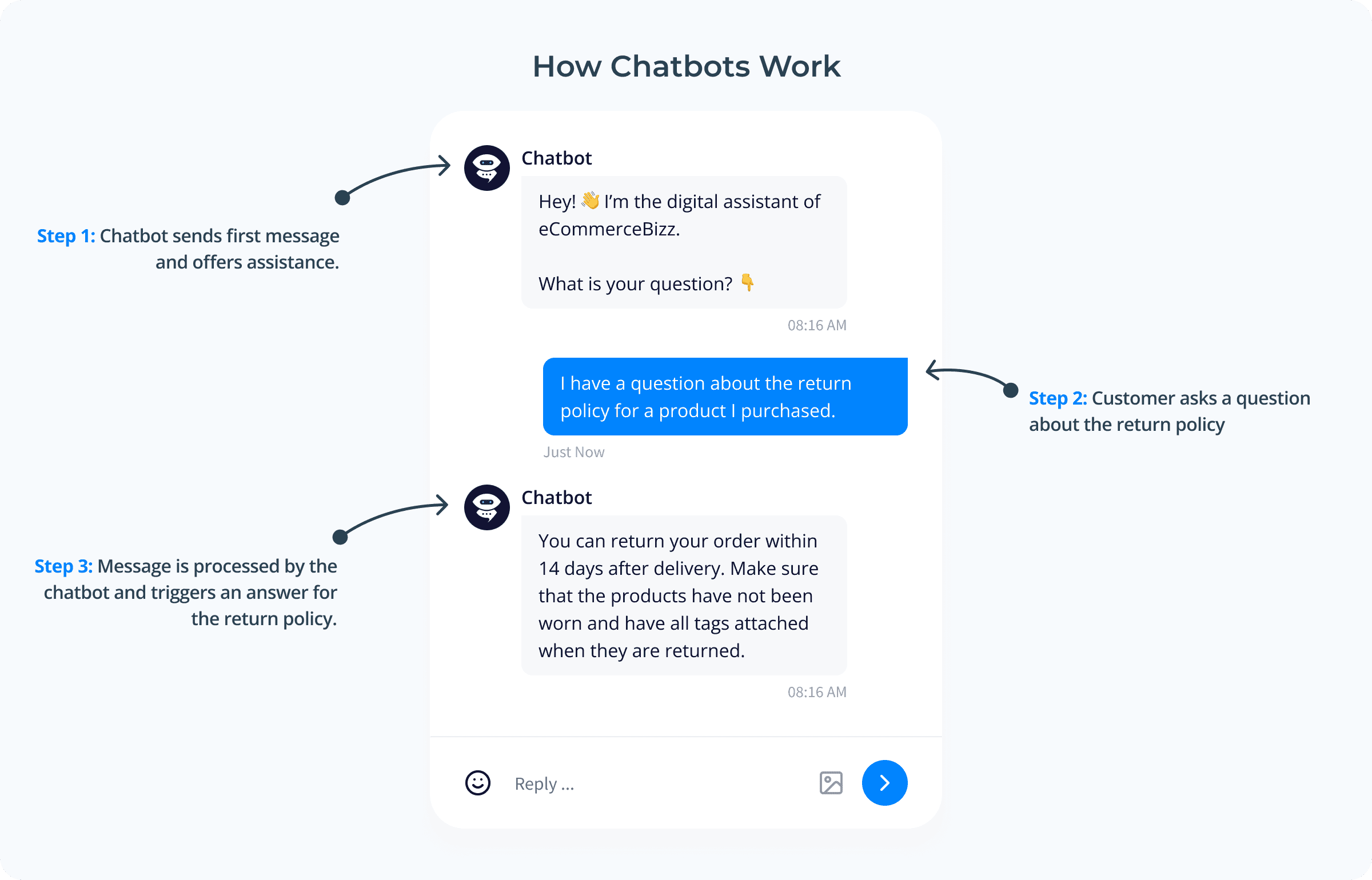
- Someone starts a conversation, and the chatbot sends a welcome message
- The user asks a question (for example: “What’s your return policy?”)
- The chatbot processes that message
- The chatbot sends a reply — immediately
Some chatbots reply using pre-written answers. Others use AI to understand the question and search through websites, documents, or databases to find the right response.
So when people ask, “How do chatbots work?”, the real answer is: it depends on the type of chatbot.
And that brings us to the most important part of this guide.
What Are the 4 Chatbot Types?
Not all chatbots work the same way.
The biggest difference between chatbot types is how they decide what to reply — and whether they can take actions or just answer questions.
There are four main chatbot types, ranging from very simple to very powerful.
Let’s walk through them, from basic to advanced.
1. Rule-Based Chatbots
Let’s start with the simplest kind of chatbot — the type almost everyone has interacted with at some point.
Rule-based chatbots do exactly what the name suggests: they follow rules.
If a message contains a certain word or phrase, the chatbot sends a specific, pre-written reply. Nothing more, nothing less.
For example:
- If a message contains “return” → show the return policy
- If it contains “delivery time” → show shipping information
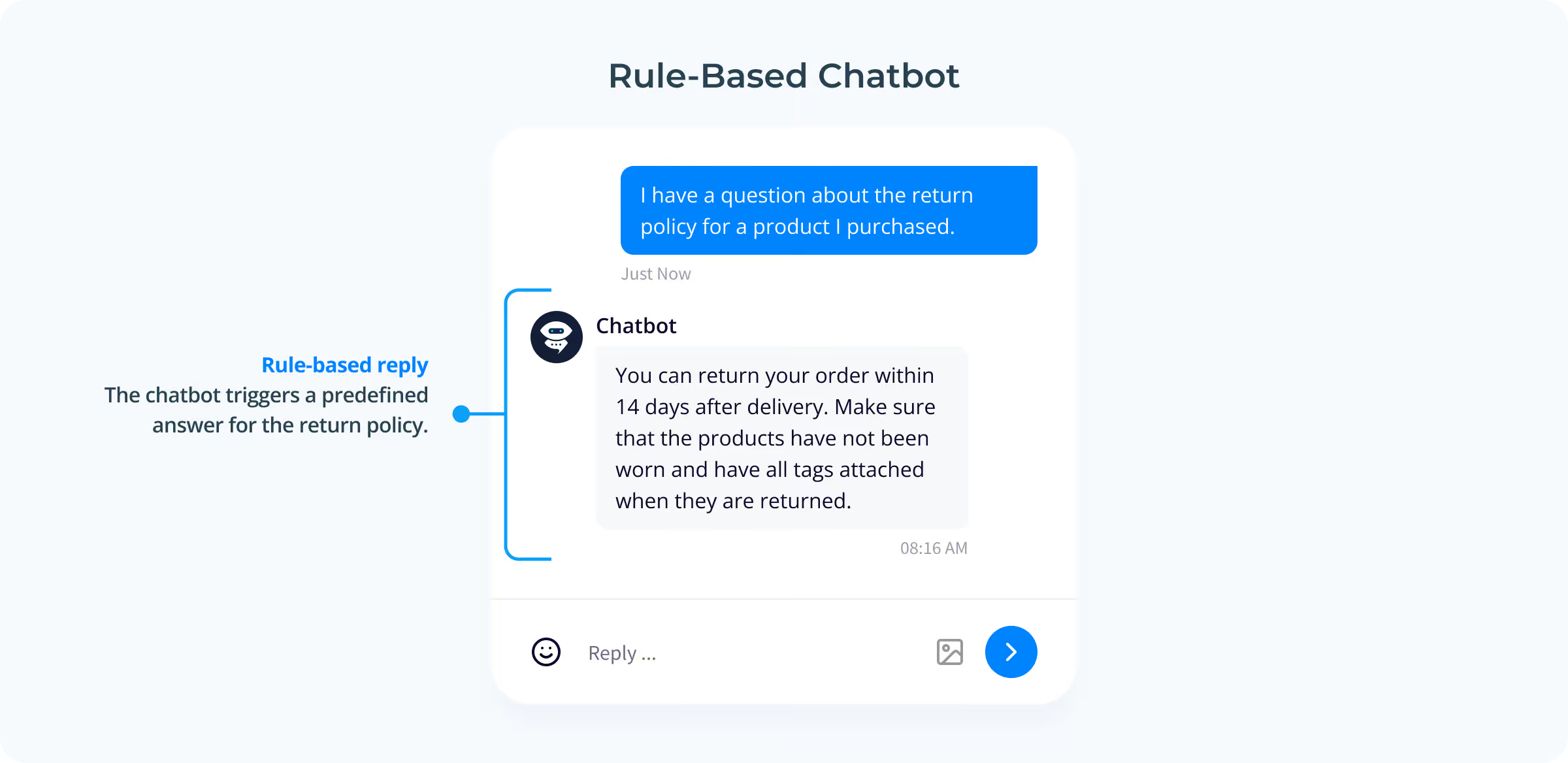
There’s no real understanding here. The chatbot isn’t thinking or interpreting meaning. It’s simply scanning for keywords and matching them to responses.
This works surprisingly well for very simple use cases.
Best for:
- Very basic FAQs
- Small websites with a limited number of questions
Limitations:
- They break easily if users phrase questions differently
- They become hard to manage as the number of rules grows
In short: rule-based chatbots are fast and predictable — but also very limited.
2. AI chatbots
AI chatbots are where things start to feel more human.
Instead of relying on fixed rules, these chatbots try to understand what the user is actually asking.
Here’s how that usually works:
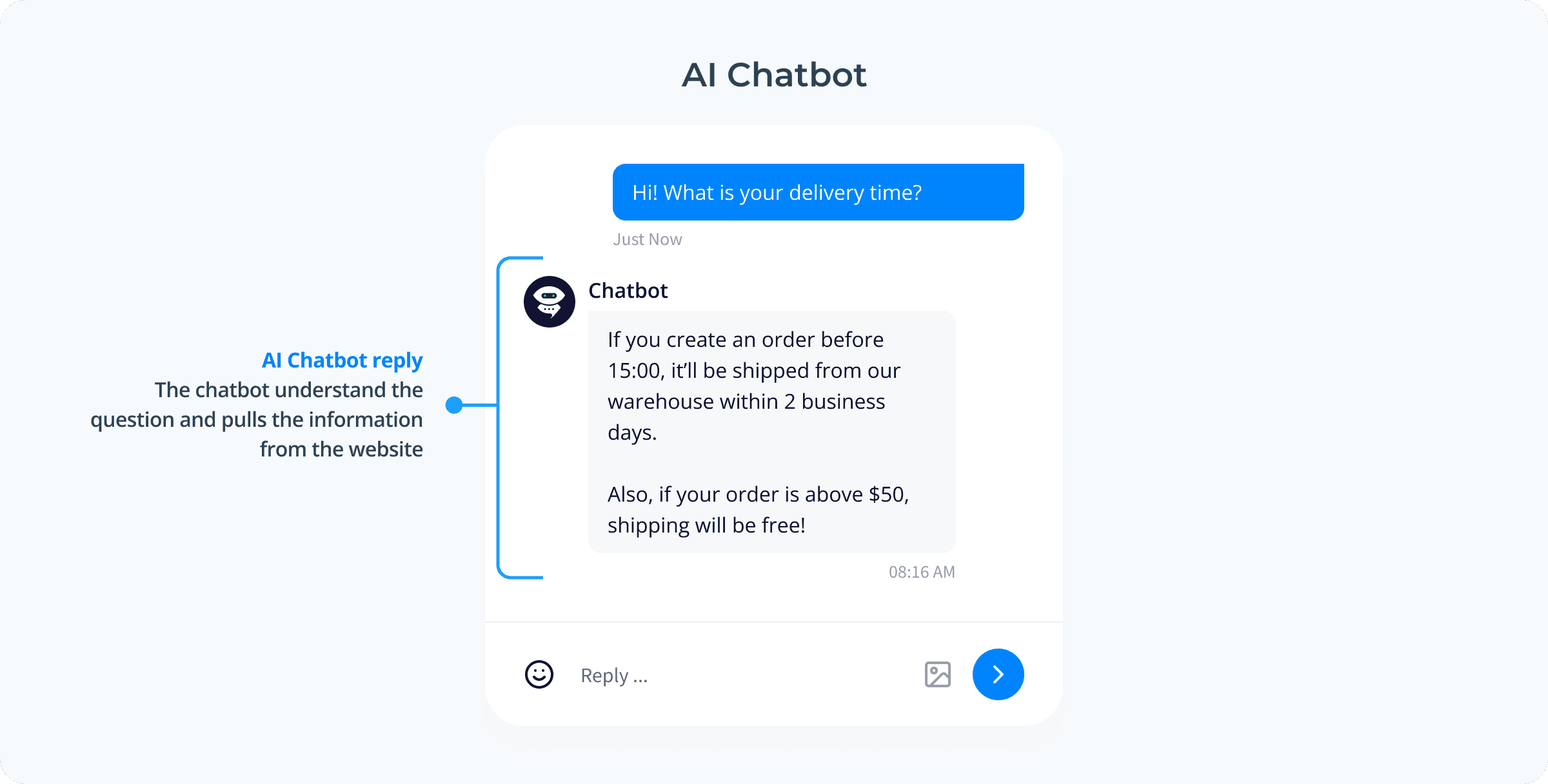
- The chatbot analyzes the message to understand intent
- It searches through your content, documents, or knowledge base
- It generates an answer that fits the question — not just the keywords
You typically train an AI chatbot on your own data. For example, with tools like Chatbase, you can upload your website pages or documents. The chatbot then “learns” from that information.

Once trained, the chatbot can automatically respond to a wide range of questions.
Best for:
- Customer support
- Knowledge bases
- Businesses with lots of content
Limitation:
- They can answer questions, but they can’t take actions
Which leads us to the next step.
3. AI agents
AI agents take everything AI chatbots can do — and add action on top.
In other words:
- AI chatbots answer questions
- AI agents answer questions and take actions (a.k.a. do things)
For example, an AI agent can:
- Look up an order status
- Check delivery dates
- Update customer details
- Pull information from a CRM or eCommerce system
Here’s how that might look in practice.
A customer asks: “When will my order arrive?”
The AI agent:
- Asks for the order number
- Pulls live data from the store’s backend
- Responds with the exact delivery date
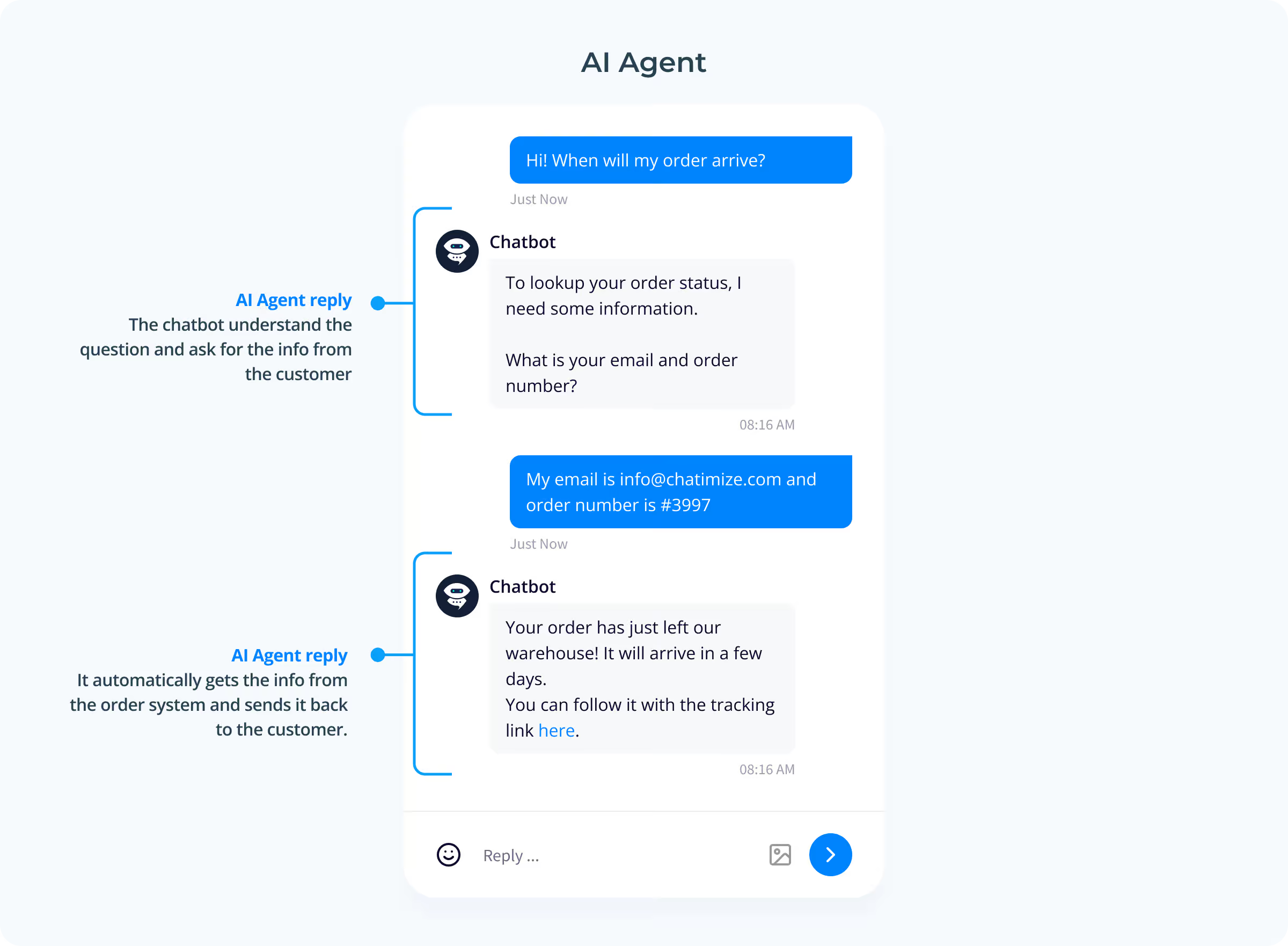
Behind the scenes, the chatbot is talking to other systems to complete tasks — not just generating text.
Best for:
- Ecommerce businesses
- SaaS support teams
- Companies with backend systems and integrations
This is where chatbots stop being “chat” tools and start becoming real assistants.
4. Hybrid chatbots
In the real world, most businesses don’t rely on just one chatbot approach.
Some questions are simple and predictable. Others require AI. And some require taking action.
That’s where hybrid chatbots come in.
Hybrid chatbots combine multiple chatbot types into a single setup:
- Simple questions → handled by rules
- Knowledge-based questions → handled by an AI chatbot
- Action requests → handled by an AI agent
For example, a chatbot might first answer a delivery-time question with a rule-based reply. Then, if the user wants to check their specific order, an AI agent takes over.
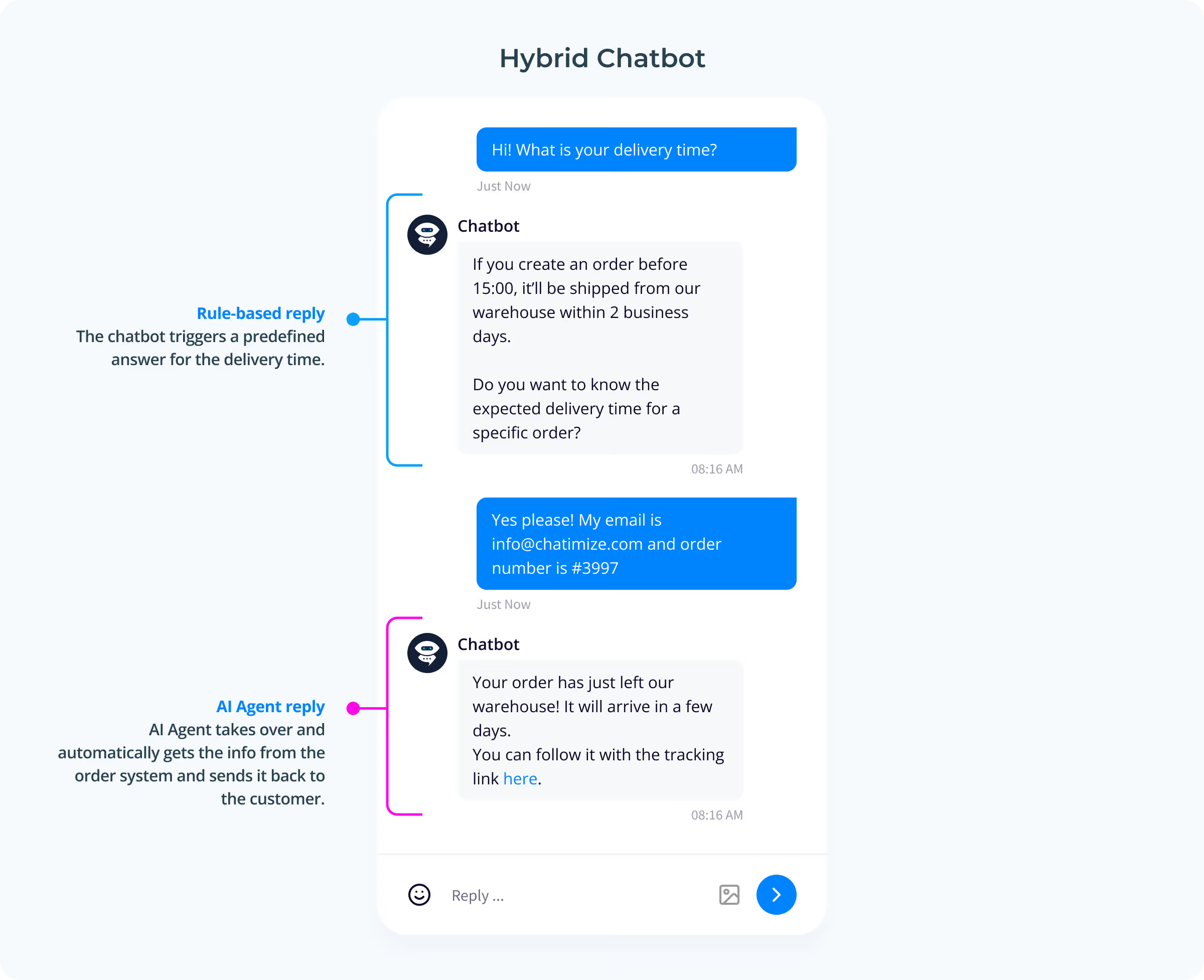
This gives you speed, accuracy, and flexibility.
Best for:
- Most real-world businesses
- Growing support teams
- Scalable chatbot setups
What Chatbot Type Is Best for You?
If you’re not sure which chatbot type makes sense for your situation, here’s a simple way to think about it.
Ask yourself these questions, one by one. The best chatbot for you will depend on your answers:
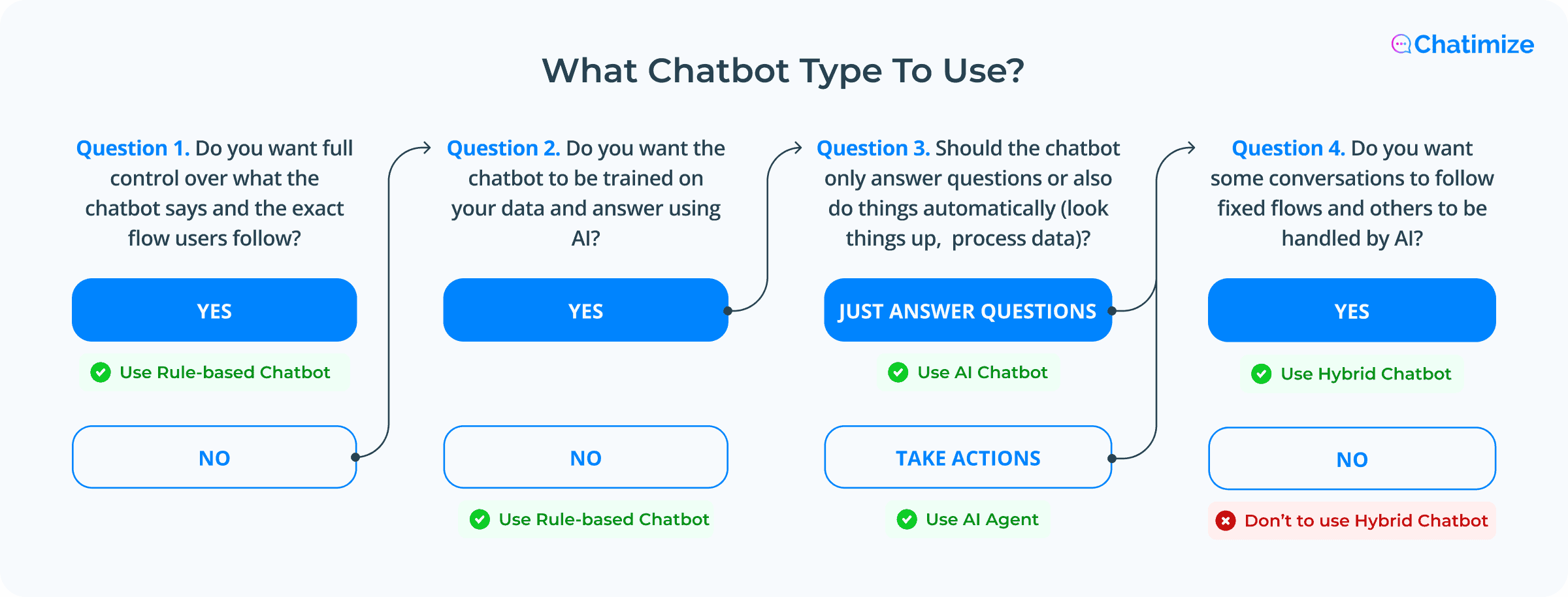
Just need basic answers? → Rule-based chatbot
Need flexible knowledge responses? → AI chatbot
Need to connect systems and perform actions? → AI agent
Need all of the above? → Hybrid chatbot
Your Next Steps
You now understand how chatbots work and the 4 main chatbot types!
The next step is choosing the setup that fits your business and building your first chatbot.
If you want to get started quickly, I have a step-by-step guide that shows you how to create an AI chatbot in less than 10 minutes
Click the link below to learn how: