If someone notices suspicious activity on their bank account late at night, they can’t wait until the next business day for support. They want help immediately.
That’s exactly where banking chatbots come in.
A banking chatbot helps banks automate customer conversations. This can include balance checks, transaction updates, loan questions, or blocked cards. Customers get quick answers. Banks reduce repetitive support work.
I’ve tested more than 200 chatbot platforms and built chatbots for hundreds of clients. And one thing is clear: banking chatbots work very well for simple, repeated requests. But not so well for complex or sensitive financial issues.
In this guide, I’ll explain:
- What a banking chatbot is
- How they work in practice
- Real-life examples (with screenshots)
- Common use cases
- The different types of banking chatbots
- Which chatbot setup makes the most sense for your institution
Let’s get started!
What Is a Banking Chatbot?
A banking chatbot is software that automatically responds to customer messages for a bank.
Instead of a human support agent, the chatbot automation manages simple conversations instantly.
That can include things like:
- Checking account balances
- Providing transaction updates
- Answering loan questions
- Helping with blocked or lost cards
- Routing customers to the right department
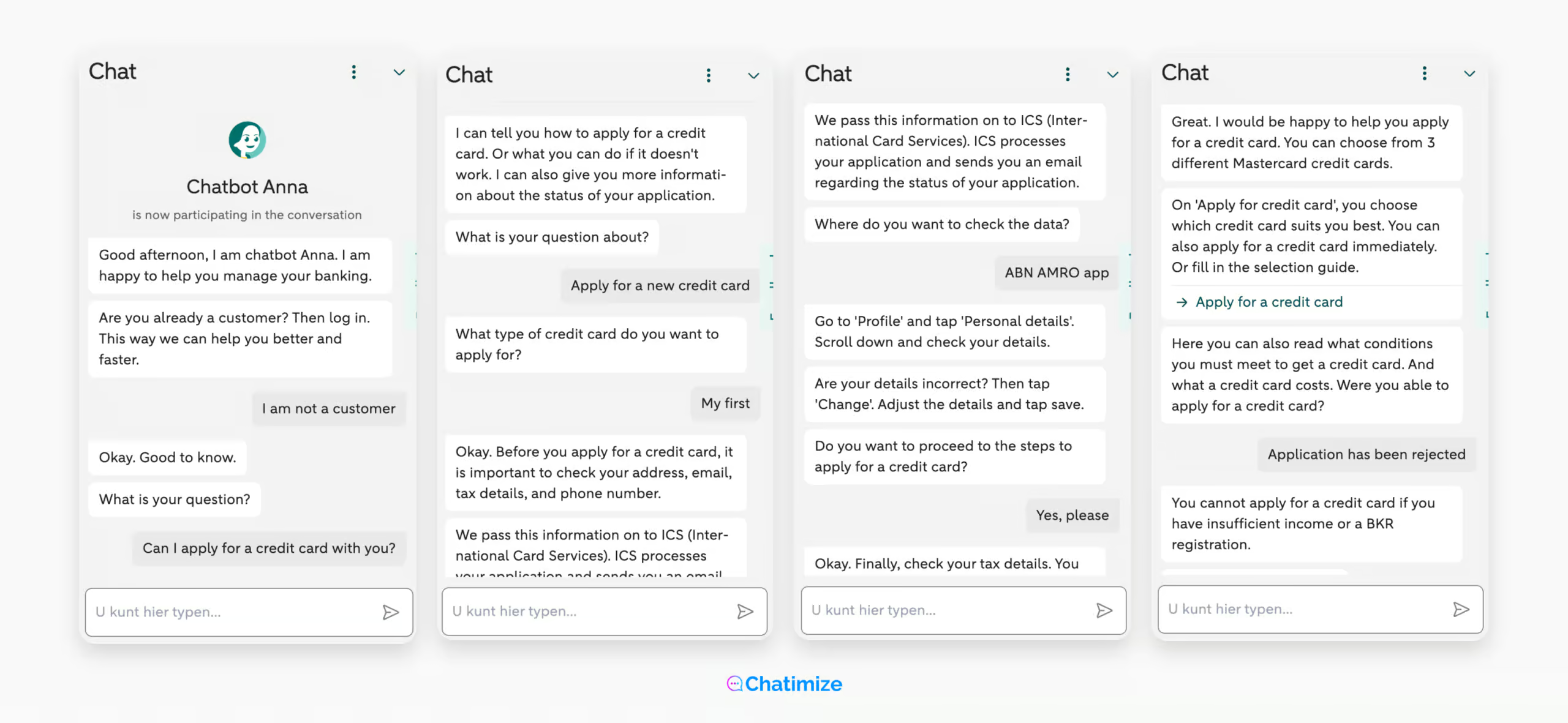
For example, here’s the chatbot of the ABN Amro bank that automatically replies to a user’s question about applying for a credit card:
Simply put, it’s like a digital assistant for banking services.
It works with different channels, such as:
- Bank websites
- Mobile banking apps
- SMS in some cases
From the customer’s perspective, it feels like a normal chat conversation. From the bank’s side, it reduces repetitive support work and improves response times. Plus, according to research, a chatbot can cut your costs by 30%.
And unlike human agents, chatbots:
- Work 24/7
- Respond instantly and give the consistent responses
- Handle thousands of conversations at the same time
That’s why more financial institutions are using them as a first line of support. This is especially true for repetitive and high-volume requests.
But to really understand their value, you need to see how they actually work in practice.
How Banking Chatbots Work
Fundamentally, banking chatbots do one simple thing – they respond instantly when a customer sends a message.
How the chatbot is set up determines what happens between the question and the reply. But the process follows a very straightforward flow in most cases.
It typically looks like this:
- A customer asks a question or taps a button
- The chatbot understands the request or follows a predefined flow
- The chatbot pulls information or triggers an action
- The chatbot sends a response or escalates to a human agent
Let’s make it more specific.
Imagine someone types: “What’s my current account balance?”

Here’s what happens behind the scenes:
- The customer opens the chatbot in the app or on the website and sends the message
- The chatbot receives the message
- The chatbot checks the customer’s account information and replies instantly with the balance
If the request is simple, the chatbot can handle everything on its own.
But if the request is more sensitive or complex, the chatbot can hand off the conversation to a human agent. This might happen if the topic is something like a disputed transaction or loan issue.
Banking chatbots are not meant to replace human support entirely.
They handle repetitive and predictable requests first. Then they escalate conversations that require judgment, security checks, or detailed financial advice.
While there are both pros and cons of chatbots, they are often very practical for banks and financial institutions.
Real-Life Finance Chatbot Examples
Let’s look at how they work in real situations.
Below are common examples banks and financial institutions use today. Each one shows what the customer asks, how the chatbot responds, and what happens next.
Customer Support Automation
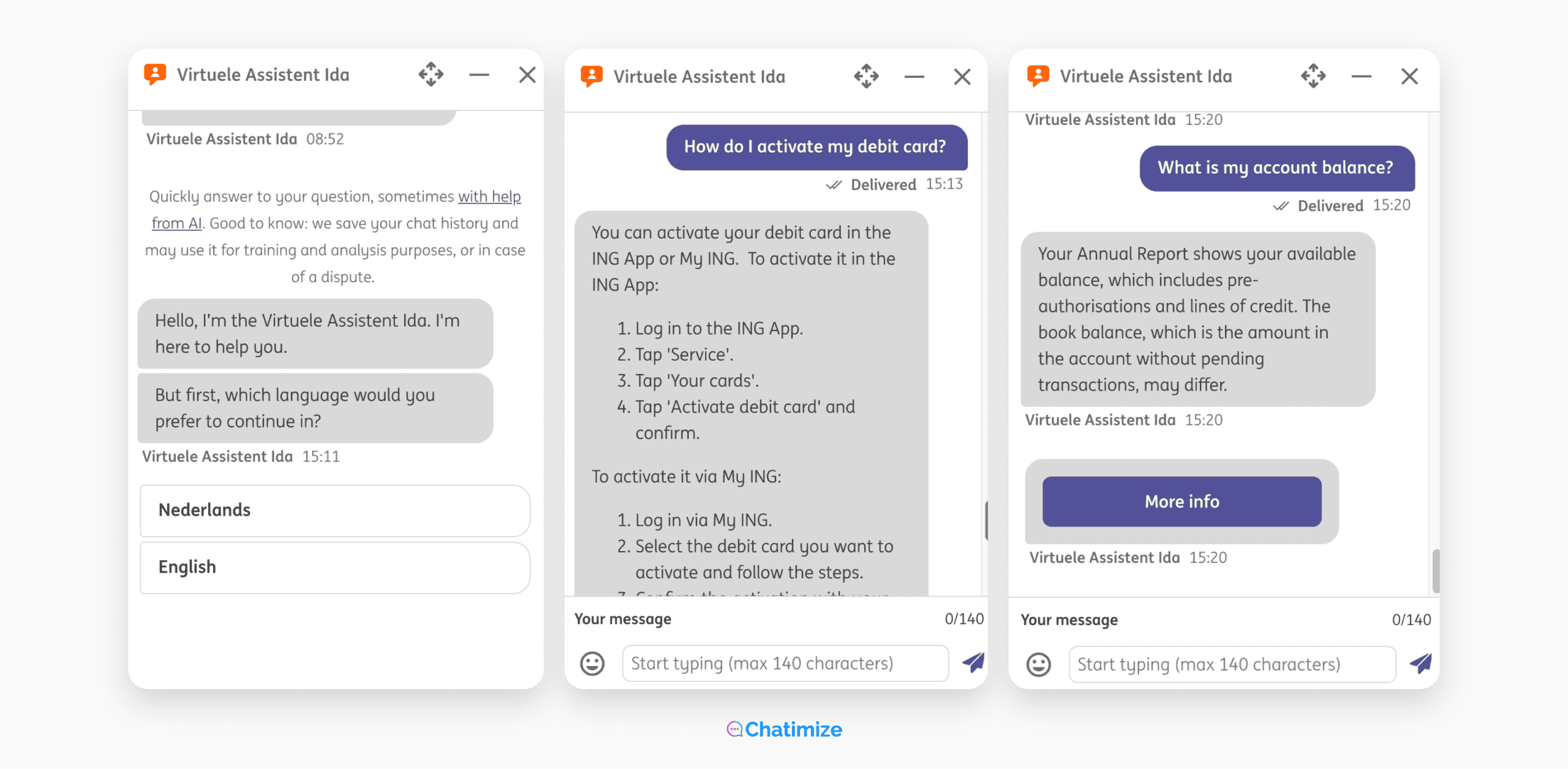
ING uses a chatbot called Virtual Assistant Ida. It answers common customer questions automatically.
Instead of calling support or searching through help pages, customers can ask questions directly inside the chat.
User asks:
“How do I activate my debit card?”
Or:
“What is my account balance?”
Chatbot replies:
The chatbot provides a direct answer and guides the customer through the next steps.
For example, when asked about activating a debit card, chatbot Ida gives step-by-step instructions for both the ING app and online banking.
For account questions, it explains what information is available. Then it provides additional help options:
What happens next:
The customer gets an immediate answer without contacting support.
If more help is needed, the chatbot can continue the conversation or direct the user to additional resources.
Account Management
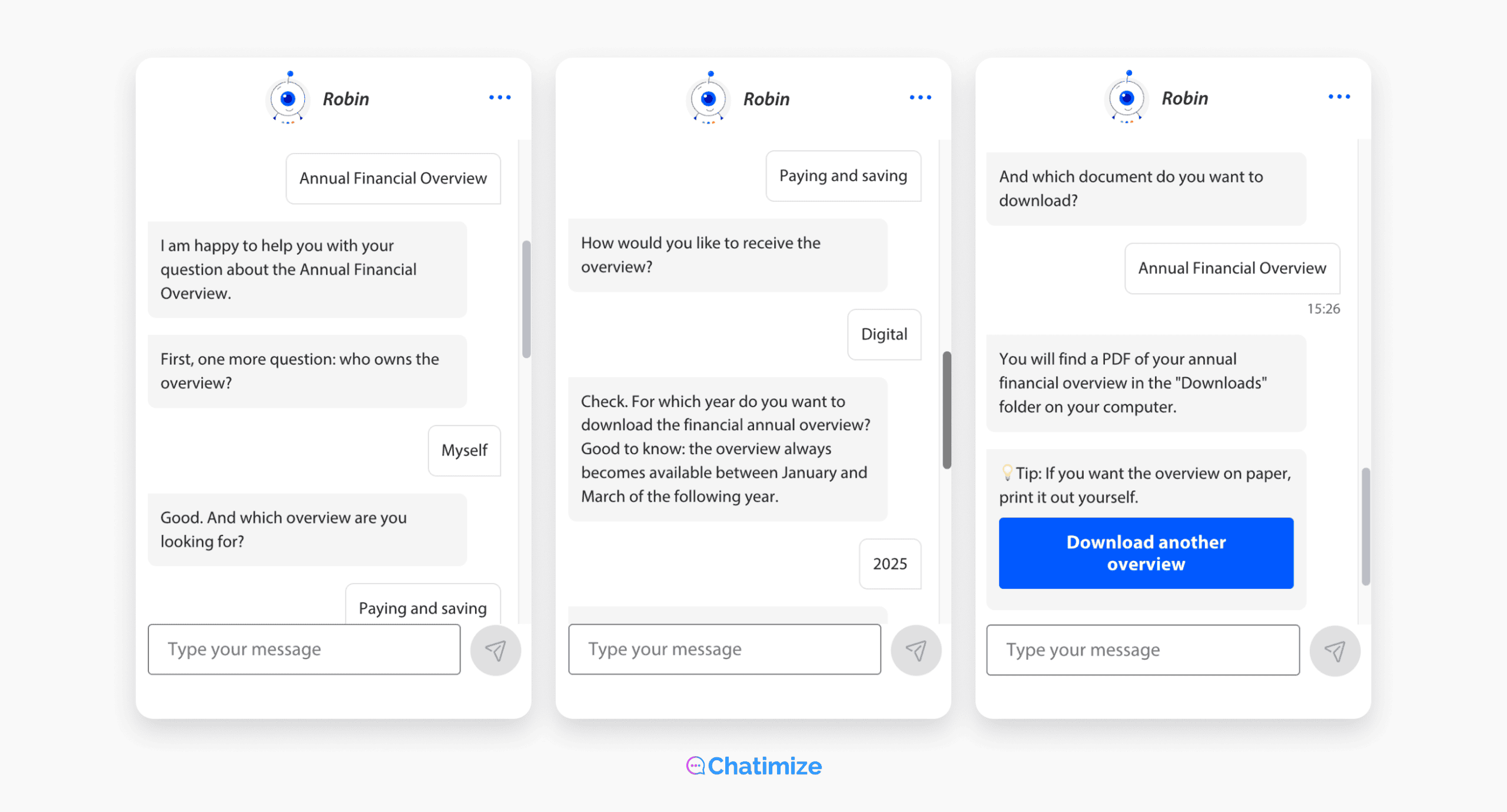
Rabobank has a chatbot named Robin. It helps customers with routine account tasks, so they don’t need to contact support.
In this example, the chatbot helps a customer download an annual financial overview.
User asks:
“I need my annual financial overview.”
Chatbot replies:
Instead of immediately sending a generic download link, the chatbot Robin guides the user through a short step-by-step flow. It asks:
- Who the overview is for
- Which account type is needed
- Whether the user wants a digital version
- Which year they want the report for
Once the details are confirmed, the chatbot prepares the correct document:
What happens next:
The customer can download the financial overview directly through the chat experience. They don’t need to call support or search through account settings.
Lead Qualification & Mortgage Calculations
Rabobank also uses its chatbot to help users explore mortgage options.
Instead of filling out a long form immediately, customers can start with a conversational mortgage calculator.
User asks:
“I want to calculate my mortgage.”
Chatbot replies:
The chatbot asks a series of qualifying questions, such as:
- Are you buying your first home?
- Are you applying alone or together?
- Do you have student debt?
- What is your income situation?
Based on the answers, the chatbot calculates an estimated borrowing amount and presents the result.
It can then guide the user toward the next step, including scheduling an appointment: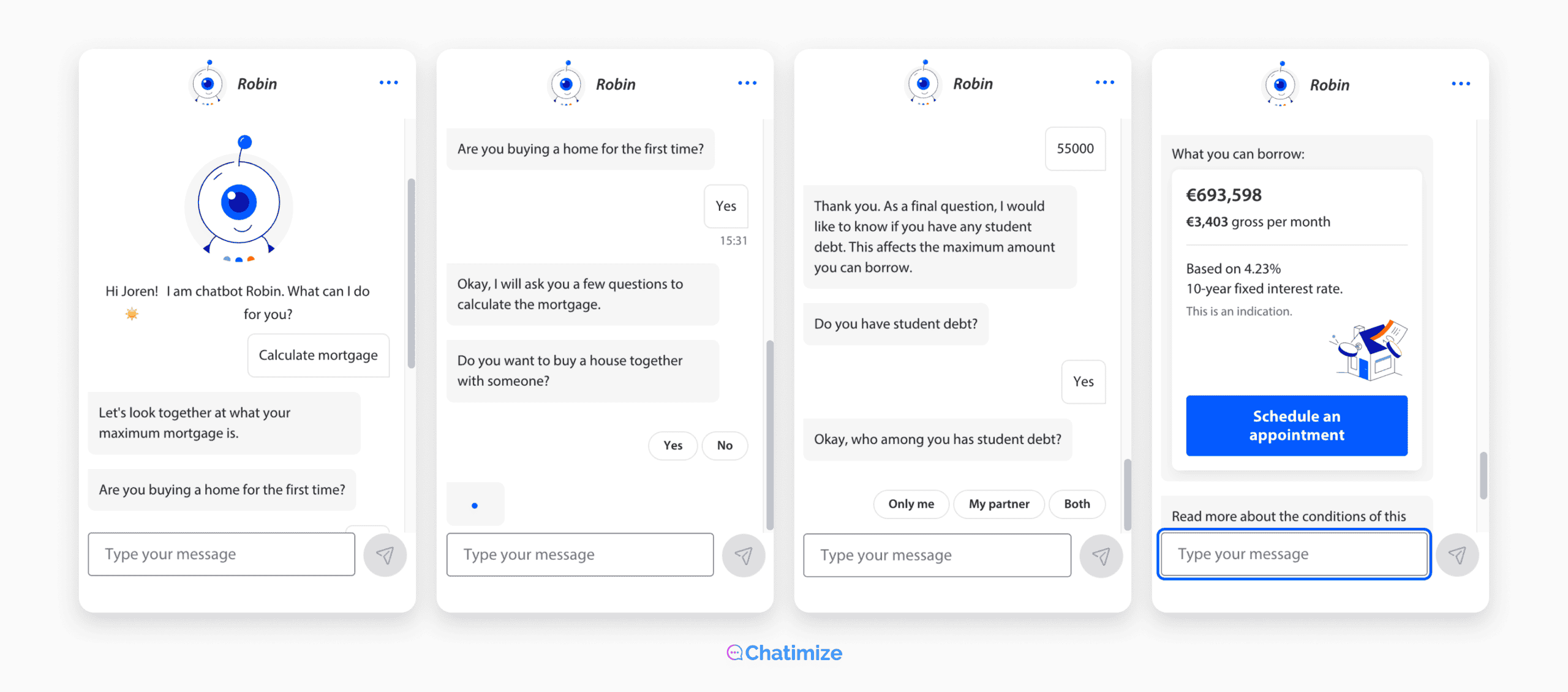
What happens next:
The customer receives a personalized mortgage estimate. They can then continue toward a consultation or application flow.
Credit Card Applications
ABN Amro uses a chatbot called Anna to guide users through the early stages of a credit card application.
Instead of sending customers directly to a long application form, the chatbot first walks them through the process step by step.
User asks:
“Can I apply for a credit card with you?”
Chatbot replies:
The chatbot asks a series of questions to understand the customer’s situation, like:
- What type of credit card are you applying for?
- Is this your first credit card?
- Have you checked your personal details in the ABN AMRO app?
The chatbot then explains how the application works, what conditions apply, and guides the customer toward the next step:
What happens next:
The customer can continue the application flow and compare available credit card options. They can also review eligibility requirements before applying.
If the customer doesn’t meet the requirements, the chatbot explains why the application may not be approved.
Payments and Transfers
Bunq is an online bank that uses an AI-powered chatbot called Finn to help customers with payment and transfer questions.
In this example, a customer contacts support about an unexpected fee on an international transfer.
User asks:
“Hey there! I got charged extra money on an international transfer. Why is that?”
Chatbot replies:
Instead of giving a generic answer, the chatbot explains several possible causes:
- Currency conversion fees
- SWIFT payment fees
- Weekend exchange markups
- Additional intermediary bank charges
When the user provides more context about the payment, the chatbot asks follow-up questions. Then it narrows down the explanation:

What happens next:
The chatbot identifies that the fee matches Bunq’s expected pricing for a US-originated SWIFT transfer.
The customer gets a clear explanation without needing to call support or wait for a human agent.
Common Banking Chatbot Use Cases
Now that you’ve seen real examples, let’s group the most common ways banks and financial institutions use chatbots today.
Most banking chatbot use cases fall into a few clear categories.
Customer Support Automation
Using a chatbot for customer service is one of the most common chatbot use cases in finance.
Banks receive a large number of repetitive questions every day.
These can include questions about:
- Branch hours
- Card issues
- Fees and limits
- Transaction status
- Loan information
- Password or login help
A chatbot can answer these questions instantly without requiring a human support agent.
This reduces support workload and helps customers get answers faster.
If the request becomes more complex, the chatbot can still escalate the conversation to a human.
Account Management
Banks also use chatbots to help customers manage everyday account requests.
This includes things like:
- Checking balances
- Reviewing recent transactions
- Finding statements
- Explaining mortgage details
- Updating account details
- Managing cards or account settings
Instead of navigating through multiple menus or contacting support, customers can simply ask the chatbot.
This creates a faster self-service experience for routine banking tasks.
Payments and Transfers
Payments and transfers are another common use case.
Customers often want quick help with moving money or checking payment activity.
For example, chatbots can help users:
- Transfer money between accounts
- Check payment status
- Confirm completed transactions
- Review transfer limits
- Get help with payment issues
In some cases, the chatbot can also trigger the action directly inside the conversation.
That makes common banking actions quicker and easier to complete.
Lead Qualification for Loans and Credit Cards
Banking chatbots are not only used for support.
They are also used to qualify leads for products like loans, mortgages, and credit cards.
When someone visits a banking website, the chatbot can ask a few questions about:
- Income
- Employment status
- Loan goals
- Preferred financial products
Based on the answers, the chatbot can recommend relevant products or route qualified leads to a sales advisor.
This creates a more conversational alternative to long forms.
Feedback Collection & NPS/CSAT Surveys
Banks also use chatbots to collect customer feedback.
Instead of sending lengthy survey forms, the chatbot can ask short questions directly after a support interaction or completed transaction.
For example:
“How satisfied are you with our Virtual Assistant today?”
Or:
“How likely are you to recommend our bank to a friend?”
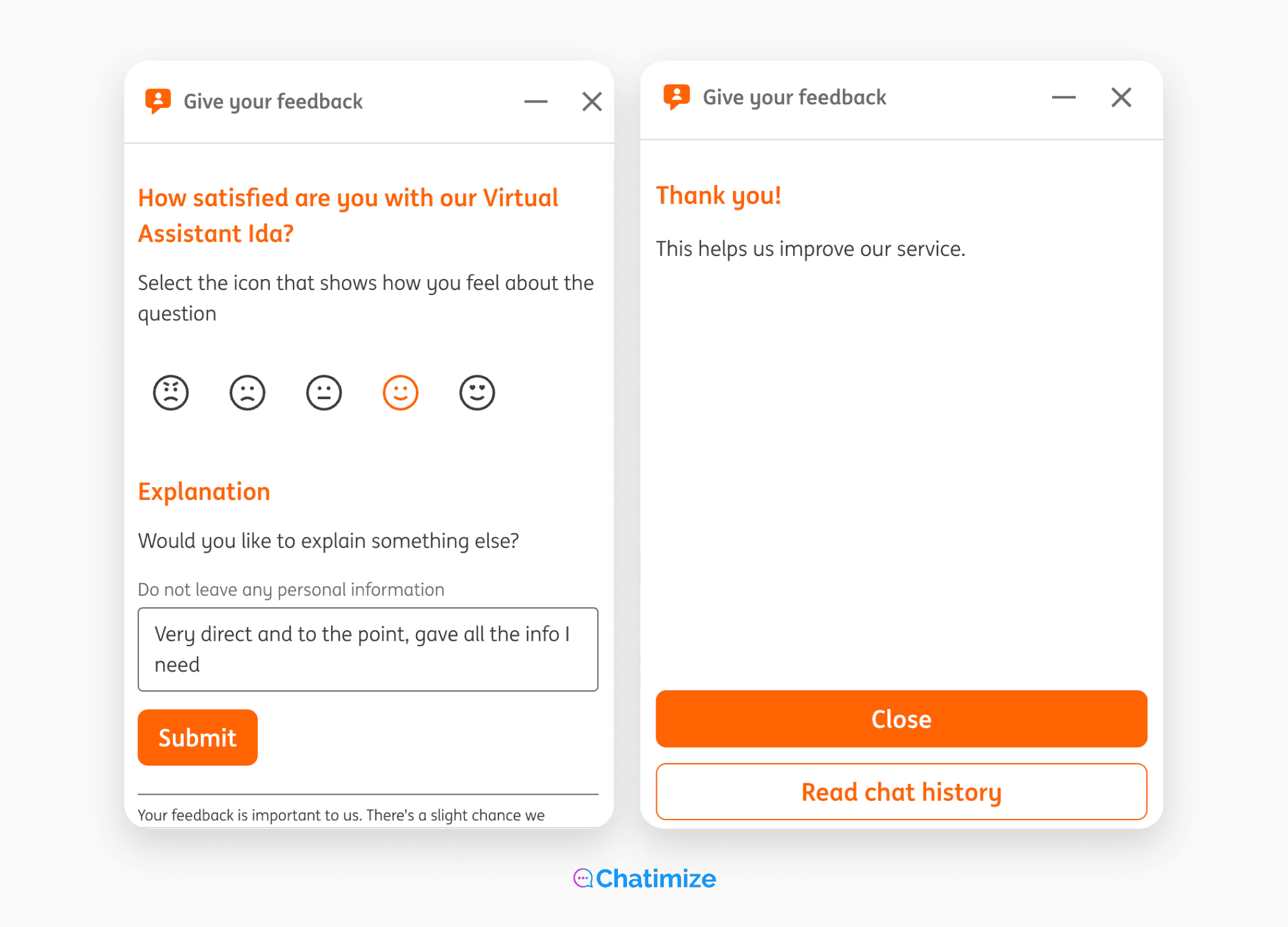
Because the interaction is quick and conversational, customers are often more likely to respond.
This helps banks collect feedback faster and better understand customer satisfaction.
Types of Chatbots for Banking
Not all banking chatbots work the same way.
The main difference between different chatbot types is how they decide what to reply. Some only answer questions. Others can perform actions inside banking systems.
There are four main chatbot types, from simple rule-based systems to more advanced AI agents.
Let’s go through them one by one.
1. Rule-Based Banking Chatbots
Rule-based chatbots are the simplest type.
Like their name suggests, they follow predefined rules and conversation flows.
When a customer clicks a button or uses a specific keyword, the chatbot provides a predefined response.
For example:
- Customer clicks “Lost card” → chatbot shows the card blocking process
- Customer asks about branch hours → chatbot provides opening times
- Customer selects “Download statement” → chatbot starts a guided workflow
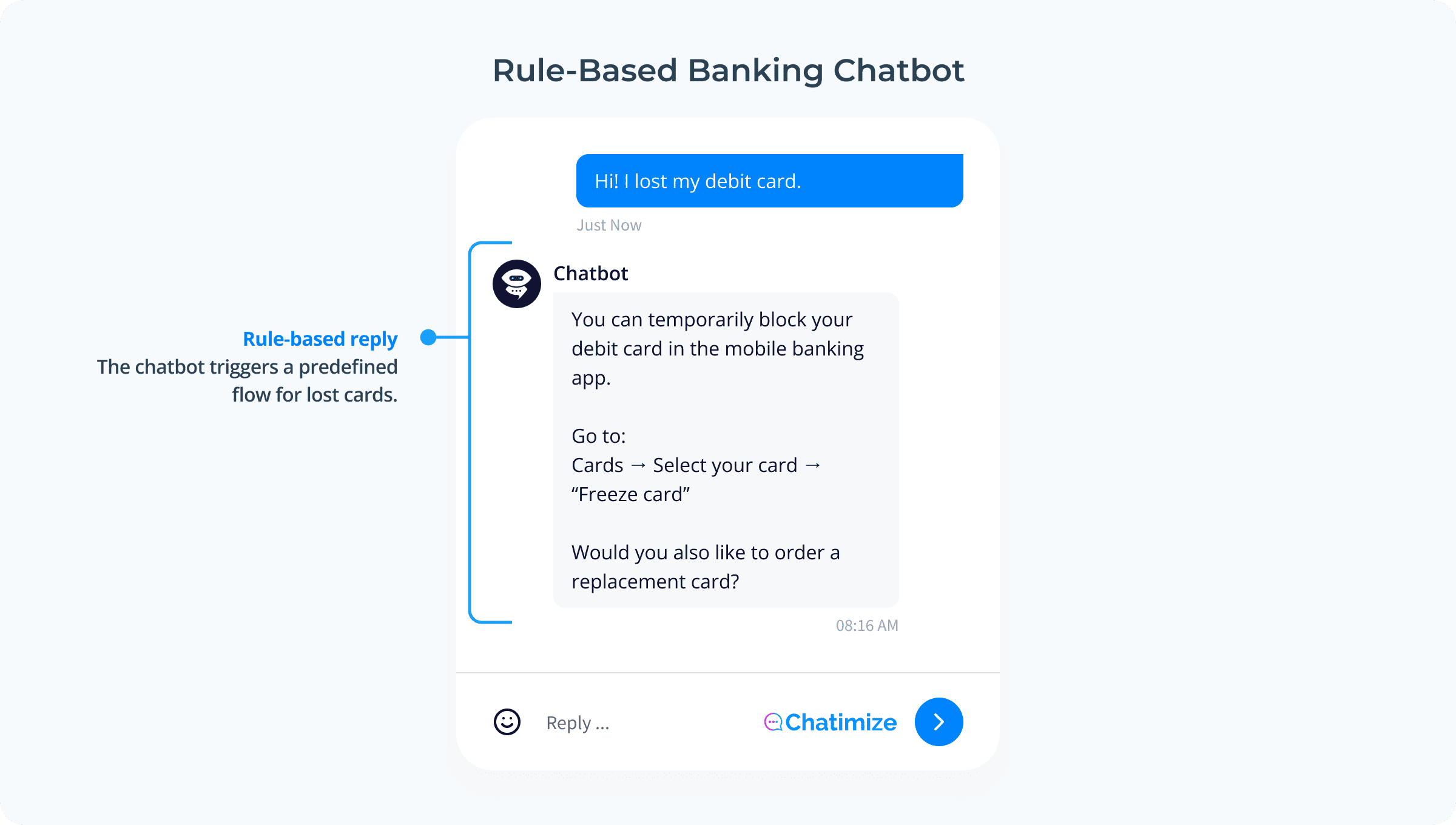
Everything is structured, predictable, and controlled.
That’s one reason why rule-based chatbots are popular in banking environments.
Best for:
- FAQs and customer support
- Structured banking workflows
- Compliance-sensitive information
- Predictable customer requests
Limitations:
- Struggles with unexpected questions
- Requires predefined flows for every scenario
Rule-based chatbots are very reliable. But they aren’t flexible.
2. Banking AI Chatbots
Banking AI chatbots are more flexible.
Instead of relying only on rules, they try to understand what the customer actually means.
That allows them to handle broader questions and more natural conversations.
For example:
- “Why was I charged this fee?”
- “How do I activate my debit card?”
- “Can I apply for a loan with your bank?”

An AI chatbot can understand the intent behind these questions and search for the most relevant answer.
This makes them useful for customer support, help content, and knowledge-based questions.
Best for:
- Customer support automation
- Banking FAQs and knowledge questions
- Handling free-text customer requests
- Larger support environments
Limitations:
- Less predictable than rule-based systems
- Depends on the quality of training data and setup
AI chatbots are more powerful, but they usually focus on answering questions rather than performing banking actions.
3. AI Agents (Modern Approach)
AI agents go a step further.
They don’t just answer questions. They can also interact with internal systems and perform actions.
For example, an AI agent may be able to:
- Check a customer’s account balance
- Get transaction details
- Trigger a card freeze
- Update customer information
- Start a payment or transfer workflow
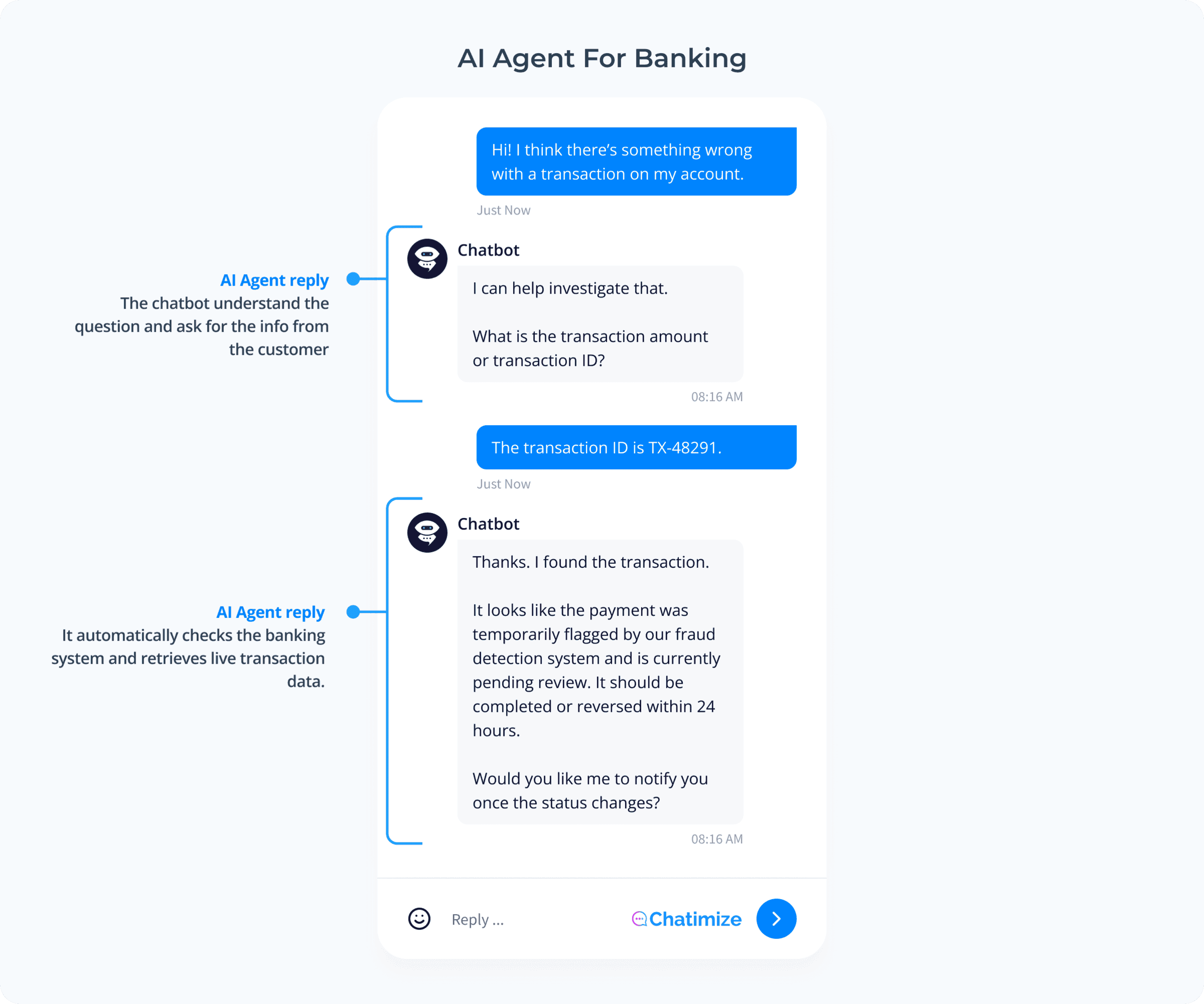
Instead of acting only as a support layer, the chatbot becomes connected to banking software and customer systems.
That makes AI agents especially useful in more advanced banking environments.
Best for:
- Self-service banking experiences
- Account lookups and transaction support
- Banking systems with integrations
- Advanced automation initiatives
Limitations:
- Harder to set up
These are very powerful, but usually more complex to implement than standard chatbots.
4. Hybrid Banking Chatbots
In practice, most banks don’t rely on only one chatbot type. Similar to eCommerce chatbots, banking environments often combine multiple approaches.
They use hybrid chatbots that combine rules, AI understanding, and sometimes AI agents.
That’s because different banking tasks need different levels of control and flexibility.
For example:
- FAQs → handled through rule-based flows
- Customer questions → handled through AI responses
- Banking actions → handled through integrated systems or AI agents
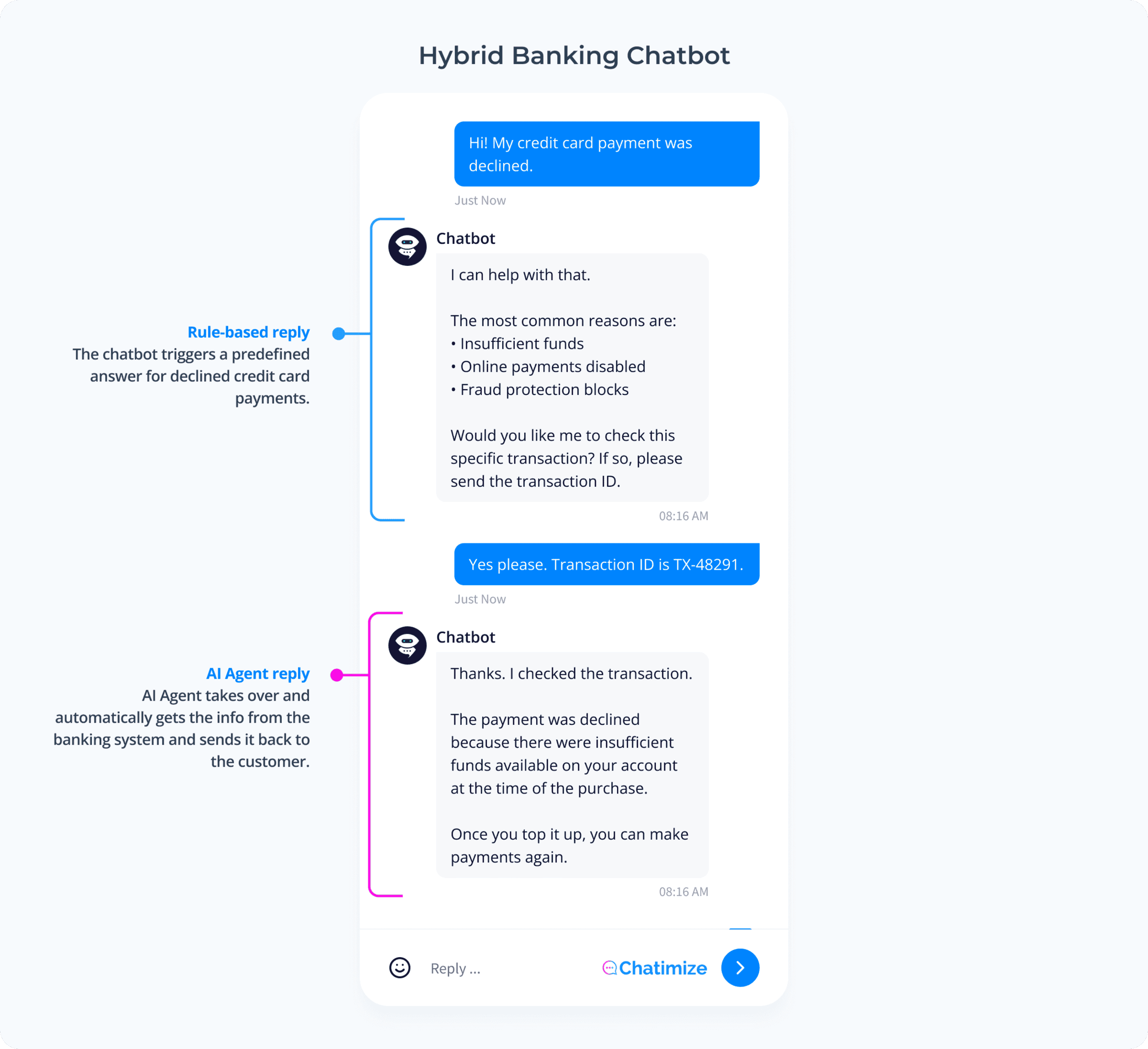
This setup balances predictability, flexibility, and automation.
That’s especially important in banking, where compliance, security, and customer experience are very important.
Best for:
- Most banks and financial institutions
- Scaling chatbot automation safely
- Balancing control with flexibility
- Regulated banking environments
For most organizations, best chatbots are hybrid. This is the most practical and scalable approach.
Which Banking Chatbot Type Is Best for You?
The best setup depends on your size, goals, systems, and compliance requirements.
Small Banks and Financial Businesses
If you mainly need help with FAQs, customer support, or simple workflows, a rule-based or AI chatbot is often enough.
For example, you might use a chatbot for:
- Account questions
- Basic support requests
- Loan information
- Customer onboarding questions
These setups are usually easier to launch and manage.
Large Banks and Enterprise Environments
Larger banks often need deeper integrations and more advanced chatbot automation.
That can include:
- Account lookups
- Transaction support
- Payment workflows
- Internal system integrations
In these cases, AI agents or hybrid banking chatbots are often a better fit.
They allow the chatbot to do more than just answer questions.
Regulated Banking Environments
Banking is a highly regulated industry. That means predictability, compliance, and security are important.
For some use cases, banks prefer rule-based flows because they provide more control over what the chatbot says and does.
But that doesn’t mean you must avoid AI completely.
Many banks use hybrid setups that combine structured flows with AI responses where flexibility is useful.
Internal vs Customer-Facing Chatbots
Not every banking chatbot is customer-facing.
Some chatbots are built for internal teams. For example, banks may use internal chatbots to help employees:
- Find policies and procedures
- Access internal knowledge
- Get compliance information
- Answer operational questions
Customer-facing chatbots often need stronger controls around security, customer data, and integrations.
Internal chatbots usually have different requirements and more flexibility.
There is no one-size-fits-all chatbot.
- The right approach depends on:
- What you want the chatbot to do
- How much control you need
- How complex your banking environment is
For many banks, the most practical approach is to start simple and expand over time.
Your Next Steps
That’s it! You now understand what banking chatbots are, how they work and the main types.
The next step is to choose the best setup for you and build your own chatbot.
It’s actually quite easy to do. To get started quickly, I have a simple step-by-step guide that teaches you how to create a chatbot in less than 10 minutes.
Click the link below to learn how:
How to Create AI Chatbot in Less Than 10 Minutes
Frequently Asked Questions
Are banking chatbots secure?
They are generally secure, but it depends on how they are built and set up.
Banks typically use security measures to protect customer data. These include authentication, encryption, and access controls.
That said, not every chatbot should have access to sensitive banking systems. Many banks use different setups depending on the use case.
For example, a simple FAQ chatbot may not access customer data at all. But an AI agent connected to banking systems usually requires stricter controls.
Can banking chatbots work with existing banking systems?
Yes. Many banking chatbots can connect with existing systems through APIs and integrations.
Depending on the setup, a chatbot may connect to:
- Core banking systems
- CRMs
- Payment systems
- Customer databases
- Internal knowledge bases
These integrations allow chatbots to do more than answer questions. They can also retrieve account information, check transactions, or support banking workflows.
Do banking chatbots replace human support agents?
No. In most cases, they are designed to support human teams, not replace them.
They are usually best at handling repetitive and structured requests. These include FAQs, account questions, or basic onboarding flows.
A human agent is still required for more complex situations, such as:
- Disputes
- Sensitive financial advice
- Unusual account issues
What is the difference between a rule-based and an AI banking chatbot?
A rule-based chatbot follows predefined flows. It only responds to the exact keywords or button clicks it was programmed for.
An AI chatbot understands natural language, so it can respond to a wider range of questions even if the customer phrases them in unexpected ways.
Most modern banking environments use a hybrid of both.
How long does it take to implement a banking chatbot?
It depends on how complex the setup is.
A simple FAQ chatbot can be live in days. A more advanced AI agent connected to core banking systems, CRMs, and payment platforms typically takes weeks to months. It depends on the institution’s technical environment and compliance requirements.